



The White House is stepping into one of the most sensitive fights in US crypto policy.
Administration officials are expected to meet law-enforcement groups today (June 10, 2026) to discuss concerns over the Digital Asset Market Clarity Act.
The talks come at a critical moment for the bill.
The agenda is expected to focus on law-enforcement objections to developer protections and illicit-finance provisions in the CLARITY Act. Those issues could determine whether the bill remains a broad crypto market-structure framework or becomes a narrower package with tougher obligations for decentralized finance participants.
The meeting also comes as more than 200 crypto companies and industry groups urge Senate leadership to move the legislation toward a floor vote.
That lobbying push reflects a familiar calculation in Washington.
Crypto has momentum, but not yet enough certainty.
The CLARITY Act has already cleared the Senate Banking Committee. According to the Senate Banking Committee, the bill advanced in a 15-9 vote in May, marking one of the most significant steps yet for US digital asset market-structure legislation.
But the bill still faces a higher bar on the Senate floor.
It will likely need 60 votes to overcome procedural hurdles. That makes the White House meeting more than a routine policy discussion.
It is a test of whether crypto firms, law-enforcement agencies, banking interests and Senate negotiators can settle the remaining language before the legislative window narrows.
What the meeting is about
The White House meeting is expected to focus on one of the most contentious parts of the CLARITY Act: how far legal protections should extend for non-custodial software developers and decentralized infrastructure providers.
Those provisions are central to the crypto industry’s support for the bill.
Developers argue that writing open-source code, building self-custody tools or publishing decentralized protocols should not automatically make them brokers, exchanges, money transmitters or financial intermediaries.
Law-enforcement officials have a different concern.
They worry that broad exemptions could create blind spots for money laundering, sanctions evasion, ransomware payments and other illicit-finance risks.
That is the core tension.
Crypto advocates want clear legal protection for builders who do not custody customer assets or control user transactions. Law-enforcement groups want assurance that the bill does not make it harder to pursue bad actors using decentralized systems.
According to the CLARITY Act text published by the Senate Banking Committee, the bill is designed to create a system for regulating the offer and sale of digital commodities by the Securities and Exchange Commission and the Commodity Futures Trading Commission.
But the hardest part is not only defining assets.
It is defining responsibility.
The discussion is also expected to cover the bill’s illicit-finance provisions.
Under the CLARITY Act framework, digital commodity intermediaries would face compliance duties. Those could include anti-money-laundering requirements and obligations tied to customer protection.
But the harder question is how those duties apply to decentralized platforms, front-end interfaces, wallet software and protocol developers.
That’s important.
If the final text treats too many software providers as financial intermediaries, DeFi development in the US could face higher legal risk. If the text is too loose, critics will argue Congress is creating an enforcement gap.
Today’s meeting is therefore about language, but also about the allocation of legal responsibility.
Who is responsible when a user interacts with open-source code? Who must monitor flows? Who is exempt because they do not control assets? Who remains liable because they operate a front end, collect fees or exercise governance influence?
Those are no longer theoretical questions.
They will decide how much of DeFi can operate inside a US regulatory perimeter and how much migrates offshore.
Why the CLARITY Act matters for crypto
The CLARITY Act is the most consequential US crypto market-structure bill now moving through Congress.
Its basic aim is to define when digital assets fall under the SEC and when they fall under the CFTC.
That distinction has shaped nearly every major crypto-policy dispute in the US.
For years, crypto companies have argued that the SEC has relied too heavily on enforcement actions rather than clear rules. The SEC, in turn, has argued that many token offerings and trading platforms already fall under securities laws.
The CLARITY Act attempts to resolve that fight by creating a statutory framework.
It would define categories of digital assets, set disclosure obligations, create registration pathways and outline when digital assets can be treated as commodities rather than securities.
According to Elliptic, which tracks crypto regulation and illicit-finance risk, the Senate Banking Committee’s passage of the CLARITY Act was a key step toward a possible full Senate vote. Elliptic also noted that prior negotiations had already focused on disputes between crypto firms and the banking industry, including whether intermediaries should be allowed to offer yield on stablecoin holdings.
That fight shows why the bill matters beyond crypto exchanges.
It could shape stablecoin rewards, tokenized assets, custody, broker-dealer obligations, DeFi interfaces and institutional infrastructure.
The bill is not only about compliance for the crypto industry. It is about business planning.
Without clearer rules, exchanges, wallet providers, token issuers, stablecoin firms and institutional infrastructure companies must make long-term decisions under legal uncertainty.
Marcos Viriato, CEO and co-founder of Parfin, said the industry push behind the bill reflects a broader cost of policy ambiguity.
“The growing industry support for the CLARITY Act highlights a broader challenge facing digital asset markets: uncertainty is becoming more costly than regulation itself,” Viriato said.
“Banks and financial institutions can adapt to regulation – that’s what they do. The bigger challenge is investing in the right infrastructure, building products, and allocating resources when the long-term regulatory environment remains unclear.”
That point is especially relevant for institutions.
Large banks, asset managers and payment companies are unlikely to build at scale around digital assets if they do not know which regulator governs the activity, what disclosures are required, or which products could later be challenged.
“As digital finance matures, the conversation is increasingly moving beyond whether digital assets should be regulated and towards how they can be adopted at scale,” Viriato said. “Regulatory clarity gives institutions the confidence to move from experimentation to implementation.”
The argument is that crypto regulation is no longer just about token speculation.
It is about tokenized deposits, stablecoin payments, settlement infrastructure, institutional custody, real-world asset markets and programmable finance.
“The opportunity for the US is significant, but infrastructure decisions do not pause for legislative timelines,” Viriato said. “The real challenge is no longer defining the rules. It’s building the infrastructure that allows institutions to operate within them.”
That is also why the bill’s developer protections have become so important.
They could determine whether US-based builders are comfortable launching self-custody, wallet, DeFi, infrastructure and blockchain middleware products domestically.
If the protections survive largely intact, the US could become more attractive for crypto software development.
If they are narrowed sharply, the industry may get market-structure clarity for centralized platforms while leaving DeFi exposed to continued enforcement risk.
Politics are now part of the market-structure debate
The CLARITY Act has become one of the highest-profile crypto issues in Washington.
Senator Cynthia Lummis, a long-time supporter of digital asset legislation, pressed the urgency in public posts on X on June 8.
“I did not spend years on this issue to watch another country write the rules that govern the assets Americans invented. Let’s pass the Clarity Act,” Lummis wrote.
In another post, she added: “The Clarity Act passed committee. The floor is next. We did not come this far to quit at the 5 yard line.”
That message captures the industry’s fear.
If the bill does not move this session, the US risks another delay while other jurisdictions continue building crypto regimes. The European Union has already implemented its Markets in Crypto-Assets framework, known as MiCA. Singapore, Hong Kong, the UAE and other markets have also moved ahead with clearer digital-asset rules in parts of the sector.
Coinbase CEO Brian Armstrong has framed the issue as unusually bipartisan.
“The most bipartisan issue right now in DC in my view and there is just a lot of people on both sides of the aisle not to mention 50 million americans who’ve used crypto there’s about 3 million advocates who signed up to stand with crypto.org who you know wanted to elect pro crypto candidates so there’s a big movement behind this of people who just want to see clear rules on the books,” Armstrong said in a podcast with Dasha Burns on TheConversation.
That political base is one reason the bill has advanced this far. But it does not remove the obstacles.
Democrats have raised concerns about anti-money-laundering rules, consumer protection and potential conflicts of interest involving political figures and crypto ventures. Banking groups have also fought provisions tied to stablecoin rewards, warning that yield-like products could pull deposits away from traditional lenders.
Galaxy Research, in a May analysis of the Senate Banking text, said the odds of CLARITY Act passage in 2026 had improved after committee negotiations and compromise language. But it also noted that the bill’s prospects remained highly dependent on the next stages of the Senate process.
The Senate committee vote showed momentum.
The floor vote will test durability.
Market backdrop: weaker prices, stronger policy stakes
The policy push is unfolding against a weaker crypto market.
Bitcoin was trading at $60,999 on June 10 (at the time of writing), down 2.56% over 24 hours, according to CoinMarketCap data. CoinMarketCap data also showed Bitcoin’s market capitalization near $1.22 trillion and 24-hour trading volume above $36 billion.
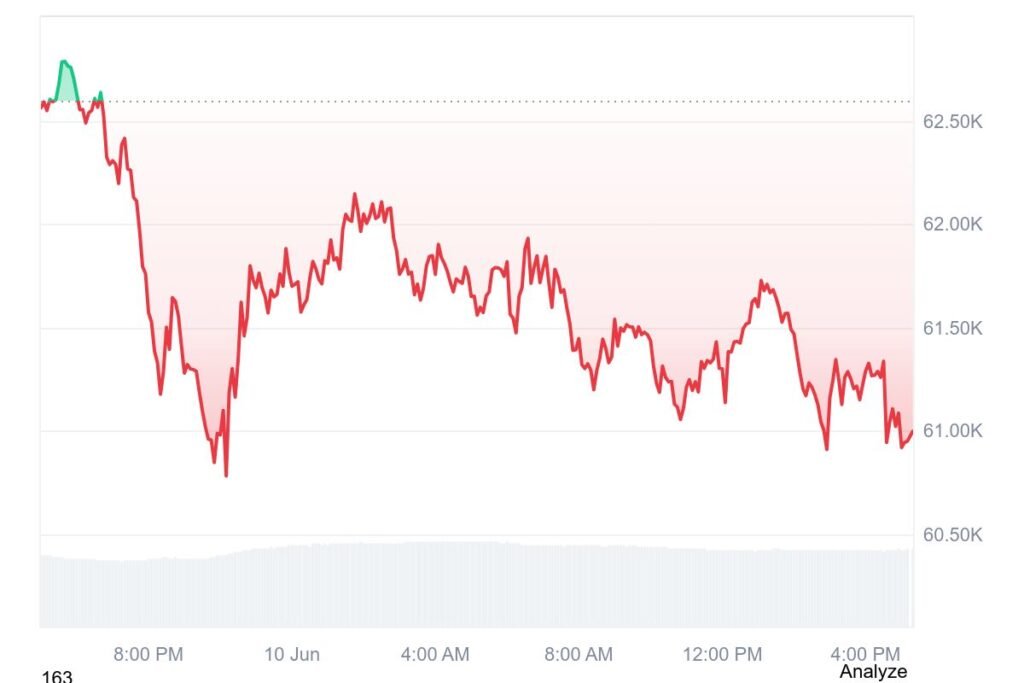
Bitcoin is roughly 50% below its all-time high of $126,198.
It’s important because the CLARITY Act debate is no longer happening during a euphoric bull market.
Bitcoin remains far below its 2025 highs. Crypto equities have also been volatile. ETF flows have softened, and investors are weighing macro pressure, regulatory uncertainty and competition from other speculative assets.
Bitcoin had fallen sharply from its peak and that capital was moving toward large private-market and technology opportunities, including the SpaceX IPO.
That broader risk rotation is worth noting.
Crypto is competing for investor capital against AI stocks, private-market tech offerings and traditional equities. At the same time, the sector is trying to persuade Washington that clearer rules could help keep digital-asset infrastructure inside the US.
A weaker market can cut both ways for legislation.
It may reduce political urgency if lawmakers view crypto as less systemically important. But it may also strengthen the case for clearer rules, especially if policymakers believe uncertainty is contributing to capital outflows and weaker domestic investment.
The industry’s argument is that market cycles should not dictate rulemaking.
Clearer laws are needed in bull markets and bear markets alike.
For institutional players, the timing may be even more important.
Infrastructure investment often happens before retail enthusiasm returns. Custody systems, tokenized asset platforms, payment rails and compliance technology require long planning cycles.
That is why Viriato’s point about infrastructure decisions not pausing for Congress is central to the current debate.
Capital can wait. Engineering teams often cannot.
What to watch next?
The first thing to watch is whether the White House meeting produces compromise language on developer protections.
If law-enforcement groups secure narrower exemptions, the bill may become more acceptable to skeptical senators. But that could weaken industry support from DeFi advocates and infrastructure developers.
The second issue is illicit finance.
Any revised text will need to show that the bill does not create safe harbors for criminal abuse. Expect lawmakers to focus on sanctions compliance, money laundering, ransomware and the obligations of platforms that have practical control over user access.
The third issue is the vote count.
The bill has committee momentum, but floor math is different. Senate leadership will need enough support to move it through procedural barriers, and some senators who backed the committee process may still demand changes before final passage.
The fourth issue is timing.
The longer negotiations drag on, the more the bill competes with other Senate priorities. That is why the industry letter from more than 200 organizations is important. It is designed to create urgency before the window narrows further.
The fifth issue is whether the House and Senate can reconcile competing versions if the Senate passes its bill.
Market-structure legislation is complex. Even after a Senate vote, final passage would still require alignment with the House and then presidential approval.
At the moment, the White House meeting is the next pressure point.
It will not decide the entire future of US crypto regulation. But it could decide whether the CLARITY Act moves forward as a broad compromise or becomes another bill slowed by the same unresolved questions that have defined US crypto policy for years.
The stakes are unusually clear.
The US is trying to write rules for a market it helped create, while the market itself is already moving.
The above article “White House Holds CLARITY Act Meeting Today as DeFi Rules Face Scrutiny” was first published on AlexaBlockchain. Read the complete article here: https://alexablockchain.com/white-house-holds-clarity-act-meeting-today-as-defi-rules-face-scrutiny/
Read Also:
Disclaimer: The information provided on AlexaBlockchain is for informational purposes only and does not constitute financial advice. Read complete disclaimer here.