




Tokenized stocks may track the same Wall Street companies, but investors are not necessarily receiving the same trade.
Execution costs on a simulated $50,000 order differed sharply across major crypto exchanges, according to a CryptoRank study published Friday. Bitget’s Reality rTokens recorded slippage that was 45% to 58% lower than the next-lowest fully executable order book across the four stocks examined.
The results expose an emerging fault line in tokenized equities.
Platforms have largely marketed these products around fractional ownership, stablecoin funding and access beyond conventional market hours. The study suggests that liquidity and market structure may matter just as much as access.
Bitget Led the Large-Order Comparison
CryptoRank compared tokenized versions of Nvidia, Microsoft, Meta Platforms and Tesla across Bitget, Binance and Gate.
Those were the only four stocks that maintained valid two-sided order books across all three exchange programs during the test. The analysis covered Reality rTokens on Bitget, bStocks on Binance and gStocks on Gate.
Bitget delivered the lowest simulated slippage for $1,000, $10,000 and $50,000 orders across all four stocks, the report found.
For the $50,000 trades, estimated slippage on its rTokens ranged from 9.6 to 13.3 basis points. That was between 45% and 58% below the next-best fully executable venue, depending on the stock.
The advantage did not come entirely from narrower bid-ask spreads.
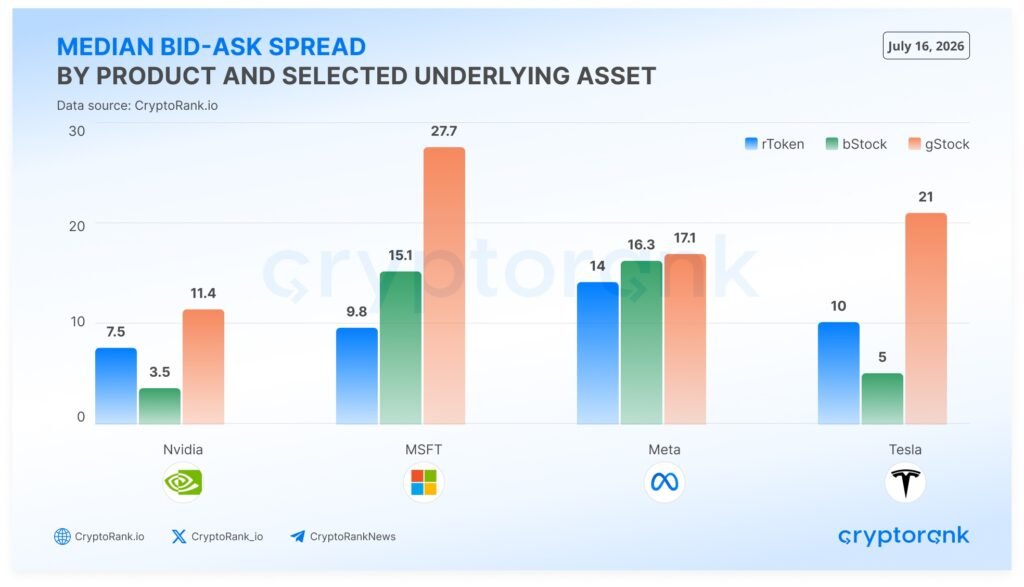
Binance’s bStocks produced the narrowest median spread for Nvidia and Tesla, while Bitget led for Microsoft and Meta. Bitget’s stronger performance on larger orders came from the volume available behind the best quoted price, according to the research.
Reality rTokens had the highest balanced displayed liquidity within 25 and 50 basis points of the midpoint across all four stocks. Median two-sided depth within 50 basis points ranged from about $169,000 to $192,000.
Median bid-ask spread by product and selected underlying
More From AlexaBlockchain
Why Execution Quality Matters
Slippage is the difference between the price visible when an order is placed and the average price at which it can actually be completed.
The cost is often negligible for small trades in liquid markets. It becomes more significant as order size grows or when an order book lacks enough buyers and sellers near the quoted price.
For a $50,000 transaction, even a relatively small difference in basis points can increase the investor’s effective entry or exit cost. Repeated across larger or more frequent trades, those differences can outweigh advertised trading fees.
The findings therefore challenge the idea that tokenized versions of the same stock are interchangeable.
A Tesla-linked token on one exchange may follow the same underlying Nasdaq-listed share as a token on another platform. However, each product trades on a separate order book, uses different market makers and may have a different mechanism for creating, redeeming or transferring tokens.
One-for-one backing alone does not guarantee that a token can be bought or sold efficiently, CryptoRank said. Transferability and accessible redemption routes also determine how quickly arbitrageurs can correct price differences.
The Test Was a Snapshot, Not a Permanent Ranking
The study carries important limitations.
CryptoRank based the comparison on displayed order books observed during a ten-minute window in regular US trading hours. The slippage figures were simulated rather than based on completed customer transactions, and trading fees were excluded.
Liquidity can change with market conditions, time of day and market-maker activity. The findings should therefore be viewed as a snapshot of executable capacity, rather than proof that one venue will always offer the lowest cost.
The limited sample also matters.
Only four stocks qualified for the cross-platform comparison. Other tokenized equities were excluded because they did not have valid two-sided books on every venue examined.
Still, the test illustrates how top-of-book prices can provide an incomplete view. A platform can show a competitive first quote while lacking enough depth to complete a larger order without moving the price.
Different Tokens Can Carry Different Rights
CryptoRank also found that matching stock tickers can hide materially different legal structures.
Reality rTokens provide contractual economic exposure but do not give holders ownership or voting rights in the underlying company. The report said each token is supported by an underlying security held through Alpaca, subject to independent reserve verification. Cash dividends are distributed in USDT.
Binance’s bStocks are structured as certificates under Abu Dhabi Global Market rules. They are backed by shares held in custody but do not confer direct ownership of those shares, according to Binance. Dividends are reinvested into the token structure.
Other products can take the form of secured notes, custodial entitlements or synthetic claims.
The US Securities and Exchange Commission has similarly distinguished between securities tokenized by issuers and products created by unaffiliated third parties. The latter can include custodial claims and instruments that provide synthetic exposure rather than direct share ownership.
That means investors must evaluate two separate questions: how reliably a token follows the underlying stock and what enforceable claim the holder has if an intermediary fails.
Bitget Links Its Books to US Equity Liquidity
CryptoRank attributed Bitget’s observed large-order capacity partly to Reality’s market architecture.
The model combines Bitget’s exchange order book with broker-linked access to liquidity associated with the underlying US equity market. That structure can help replenish quotations during supported trading sessions, although the report cautioned that architecture alone cannot guarantee execution quality.
“Tokenization is moving beyond access and into infrastructure,” Bitget CEO Gracy Chen said in a statement shared with AlexaBlockchain.
“If even 10% of global financial assets become tokenized by 2030, we’ll witness one of the most significant transformations in modern capital markets,” Chen mentioned.
“The next phase of tokenization will be defined by quality of execution, liquidity and market infrastructure supporting those assets,” Chen added.
Bitget has expanded its Stock+ offering to more than 500 stock-linked assets, including equities and exchange-traded funds. Availability depends on the user’s jurisdiction and eligibility.
Tokenized Equities Approach a Bigger Market Test
The research comes as crypto exchanges race to expand their stock-linked offerings.
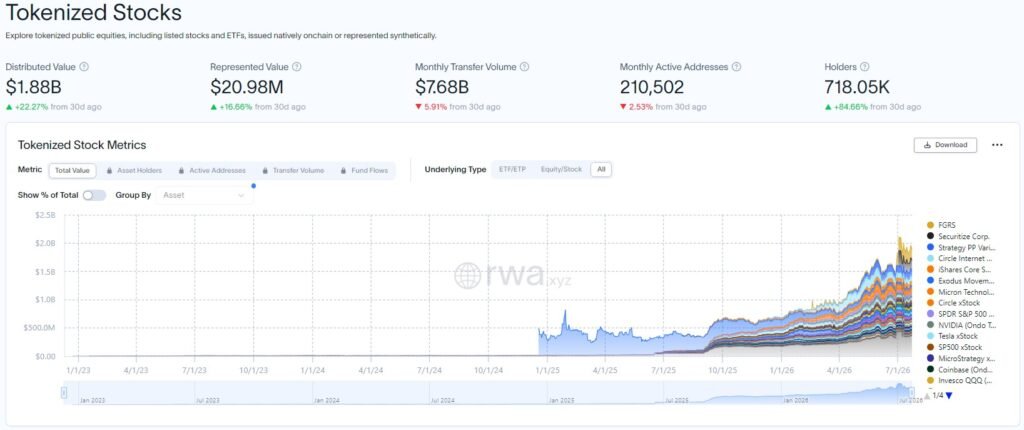
CryptoRank said tokenized equities had reached approximately $1.82 billion in distributed onchain value by mid-July, with another $21 million in represented assets. About 471,000 blockchain addresses held tokenized stocks at that point.
Those figures can vary considerably depending on which products and ownership structures a data provider includes. RWA.xyz currently reports a public-equities category of about $1.88 billion, 210,502 monthly active addresses and 718,050 holders.
The broader lesson is that issuing a blockchain representation of a stock does not automatically reproduce the quality of the underlying equity market.
Traditional US stocks benefit from consolidated pricing, multiple competing venues and deep institutional liquidity. Tokenized versions divide activity among separate exchanges, issuers, custodians and blockchain networks.
As the sector grows, platforms are likely to compete less on the number of stocks they list and more on measurable trading outcomes.
For investors, that will make order-book depth, redemption access, investor rights and all-in execution costs as important as the ticker displayed on the screen.
The above article “Tokenized Stock Trading Costs Diverge by Up to 58% Across Crypto Exchanges, Study Finds” was first published on AlexaBlockchain. Read the complete article here: https://alexablockchain.com/tokenized-stock-trading-costs-diverge-by-up-to-58-percent-across-crypto-exchanges/
Read Also: This is the First U.S.-Chartered Depository Bank to Offer Stablecoin Invoicing
Disclaimer: The information provided on AlexaBlockchain is for informational purposes only and does not constitute financial advice. Read complete disclaimer here.