




Bitcoin rebounded on Monday, offering traders a partial reprieve after a sharp liquidation-driven slide that had pushed the world’s largest cryptocurrency into one of its weakest stretches in months.
According to CoinMarketCap Bitcoin data, BTC price rose 3.7% over the past 24 hours to trade at $63,971 at the time of writing. Trading activity also picked up, with Bitcoin’s 24-hour volume rising 14.91% to $35.95 billion.
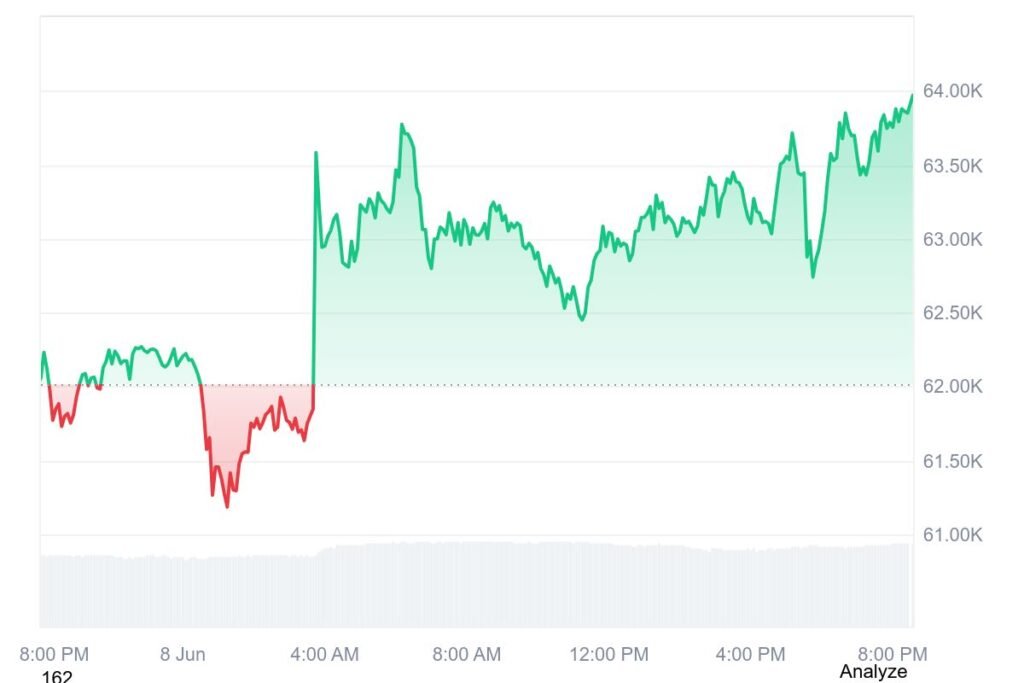
The broader crypto market advanced 2.76% to $2.19 trillion.
The move looked less like a decisive return of risk appetite and more like an oversold relief rally. After a brutal week of forced selling, traders appeared to be covering short positions and rebuilding exposure in assets that had fallen quickly.
Bitcoin liquidations totaled about $255.91 million, amplifying the rebound as bearish positions were forced out of the market.
The recovery also came with a familiar caveat: crypto is still trading like a high-beta macro asset.
The crypto market showed a 61% correlation with the S&P 500, suggesting that Bitcoin’s latest move was tied less to a crypto-specific breakout and more to a broader repricing of risk. That matters because the same macro forces that triggered last week’s pressure remain in place.
Jobs Data Reset the Fed Trade
The latest pressure on Bitcoin began with stronger-than-expected U.S. labor-market data.
The U.S. economy added 172,000 jobs in May, while the unemployment rate held at 4.3%, according to reports on the May employment release. The reading weakened the case for near-term Federal Reserve easing and pushed investors to reassess the path of interest rates.
That shift is crucial for Bitcoin.
When traders expect rate cuts, liquidity-sensitive assets tend to benefit. When those expectations fade, speculative assets often struggle.
Ryan Lee, Chief Analyst at Bitget Research, said the employment report prompted investors to reassess expectations for Federal Reserve easing in 2026.
“The May U.S. employment report prompted investors to reassess expectations for Federal Reserve easing in 2026,” Lee said. “Payroll growth of 172,000 exceeded expectations, unemployment remained at 4.3%, and wage growth showed little sign of a sharp slowdown. Markets responded by reducing expectations for near-term rate cuts, pushing Treasury yields and the U.S. dollar higher.”
The bond market became the main signal.
“The strongest signal came from the bond market,” Lee said. “Rising Treasury yields indicate investors see less urgency for monetary easing and have greater confidence that economic activity will remain resilient. The move also suggests inflation risks have not fallen enough to justify an aggressive policy shift from the Federal Reserve.”
That created a difficult setup for crypto.
Higher Treasury yields increase the opportunity cost of holding non-yielding assets. A stronger dollar also tends to tighten global financial conditions. Together, those forces can weigh on Bitcoin, Ethereum and other digital assets.
Goldman Sachs has pushed its Fed rate-cut forecast into 2027 after the stronger jobs data, citing resilient U.S. growth and inflation risks tied partly to geopolitical tensions.
It means the rebound may remain fragile unless bond yields stabilize.
Strategy’s Sale Added to Market Anxiety
The other factor hanging over Bitcoin was Strategy.
Michael Saylor’s company, long viewed as the most aggressive corporate accumulator of Bitcoin, recently sold a small amount of BTC. The sale was unusual because Strategy’s investment narrative has been built around long-term accumulation rather than disposal.
Strategy sold 32 Bitcoin, marking its first sale since 2022. The move was reportedly tied to preferred stock obligations, not a broad liquidation of its Bitcoin treasury.
Still, the optics mattered.
For years, Strategy’s role in the market was simple: it bought Bitcoin and rarely introduced doubt about its commitment. Even a small sale challenged that perception and fed concern that other treasury companies could eventually become sellers if financing conditions tightened.
That concern appears to have eased after Strategy returned to buying.
The company announced the purchase of 1,550 Bitcoin for about $101 million, increasing its holdings to 845,256 BTC. The purchase was made at an average price of $65,332 per Bitcoin.
That makes the Saylor factor more complicated.
The earlier sale may have contributed to bearish sentiment during last week’s decline, especially because it broke the “never sell” image attached to Strategy. But the latest purchase suggests the company has not abandoned its accumulation strategy.
In market terms, the sale was a sentiment shock. The subsequent purchase was a confidence repair.
It does not remove the broader question.
If Bitcoin trades under pressure for a prolonged period, investors may continue to scrutinize treasury companies that rely on capital markets to fund Bitcoin purchases, dividends or preferred-share obligations.
ETF Outflows Show Demand Has Weakened
The rebound also followed a heavy period of ETF outflows.
U.S. spot Bitcoin ETFs ended a 13-day outflow streak last week, after roughly $4.4 billion left the products. A small net inflow ended the streak, but the broader signal was weaker institutional demand compared with earlier phases of the cycle
That is important because ETFs have become one of Bitcoin’s main marginal demand channels.
During bullish periods, ETF inflows can reinforce upside by absorbing available supply. During weak periods, redemptions can become a source of pressure, especially when combined with leveraged liquidations and macro selling.
The latest bounce therefore needs confirmation from flows.
A single recovery session can be driven by short covering. A durable market turn usually requires renewed spot demand, stabilization in ETF flows and reduced macro pressure.
Geopolitical Tensions Add Another Layer
The macro picture is also being shaped by geopolitical risk.
Oil markets have been volatile as tensions involving Iran, Israel and regional shipping routes have intensified. Reuters reported that the European Union imposed sanctions on Iranian individuals and an IRGC Navy unit over actions threatening maritime traffic in the Strait of Hormuz, a critical route for global oil supply.
Oil prices also jumped as the Iran-Israel conflict escalated, before paring some gains after Iran said it would end attacks on Israel. Brent and WTI still remained elevated, with traders watching the risk of disruption around the Strait of Hormuz.
This is relevant for Bitcoin through inflation expectations.
A sustained oil shock can make central banks less willing to cut rates. It can also raise volatility across equities, bonds, commodities and digital assets. In that environment, Bitcoin’s “digital gold” narrative often competes with its behavior as a leveraged risk asset.
Last week, the risk-asset identity won.
Bitcoin fell alongside broader risk markets as yields rose, the dollar strengthened and geopolitical uncertainty increased. Gold also came under pressure as real yields moved higher, while oil remained comparatively resilient because of supply-risk concerns.
Lee said the cross-asset reaction pointed to tighter financial conditions.
“Higher yields and a firmer dollar weighed on risk assets,” he said. “Bitcoin and Ethereum moved lower as liquidity expectations were repriced, while gold retreated as real yields increased. Oil remained comparatively resilient, reflecting expectations that labor market strength could support economic activity and energy demand through the second half of the year.”
That leaves Bitcoin exposed to two competing forces.
Geopolitical fear can increase interest in alternative assets. But if the same geopolitical fear lifts oil, inflation expectations and yields, it can hurt liquidity-sensitive trades.
Altcoins Add Momentum, but Also Risk
The rally was not limited to Bitcoin.
Narrative-driven sectors, including AI-linked tokens and GameFi names, also gained as traders moved back into high-beta assets. Such moves are common during relief rallies because beaten-down altcoins often rebound faster than Bitcoin when risk appetite improves.
Regulatory sentiment also helped.
Recent SEC statements have attempted to clarify how federal securities laws apply to crypto assets, including areas such as airdrops, protocol staking, protocol mining and token taxonomy.
The broader CLARITY Act debate has also kept traders focused on the possibility of a more defined U.S. market structure for digital assets. The proposed framework would help determine how oversight is split between the SEC and CFTC, though the legislative path remains politically complex.
That regulatory backdrop is supportive at the margin. But it is not enough by itself to offset macro tightening.
Key Levels to Watch
The immediate question is whether the crypto market can hold the rebound.
The total market capitalization has recovered to $2.19 trillion. A continuation move could push it toward $2.23 trillion, a level traders are watching as a potential Fibonacci 78.6% retracement zone.
The lower boundary is more important.
If the market loses the recent weekly low near $2.1 trillion, the bounce would look more like a temporary unwind of short positions than the start of a sustainable recovery.
For Bitcoin, the key test is whether buyers can defend the recovery above the latest lows and rebuild momentum toward the mid-$60,000 range. Failure to do so would keep the market vulnerable to another round of selling, especially if Treasury yields rise further.
Lee said the broader setup remains selective.
“Taken together, the market reaction points to a reduced probability of multiple Fed cuts in 2026 and a more selective risk environment,” he said. “Treasury yields remain the key indicator to watch, as current price action reflects a market that continues to price stable growth, restrictive monetary policy, and tighter financial conditions.”
That is the central tension in Bitcoin now.
The asset has bounced because it was oversold. It has support from short covering, altcoin momentum, Strategy’s renewed purchase and tentative regulatory optimism.
But the larger market is still dealing with higher yields, ETF outflows, geopolitical stress and doubts over liquidity.
Whether the rebound becomes a recovery depends on whether macro conditions stop moving against it.
The above article “Bitcoin Rebounds to 64K After Brutal Selloff as Fed Rate Cut Bets Fade and Saylor Strategy Concerns Ease” was first published on AlexaBlockchain. Read the complete article here: https://alexablockchain.com/bitcoin-rebounds-to-64k-after-brutal-selloff-fed-rate-cut-bets-fade-saylor-strategy-concerns-ease/
Read Also: Is India Moving From Crypto Uncertainty Toward a Clearer Policy Framework?
Disclaimer: The information provided on AlexaBlockchain is for informational purposes only and does not constitute financial advice. Read complete disclaimer here.