




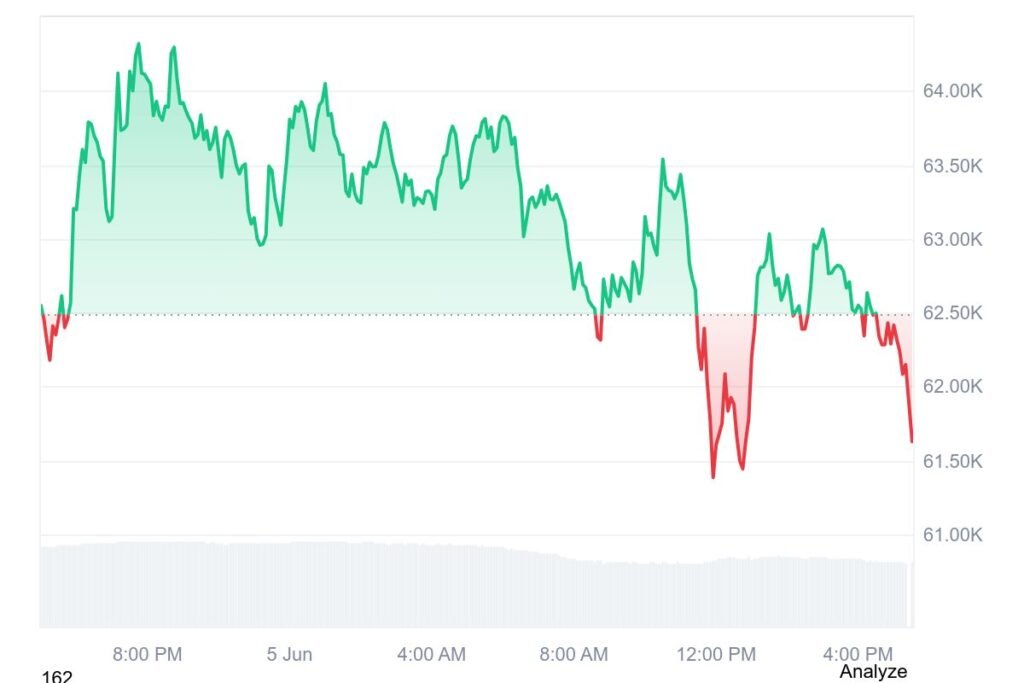
Bitcoin fell toward $61,000 on Friday, extending a weekly slide of about 16% and leaving it roughly 50% below its October 2025 record near $126,000. At the time of writing, Bitcoin was trading around $62,109, with an intraday high of $64,380 and low of $61,407, according to CoinMarketCap data.
The move capped one of the sharpest risk resets in crypto this year.
Crypto’s total market cap dropped to $2.14 trillion, as traders cut exposure across Bitcoin, Ether and smaller tokens. A mix of macro pressure, forced liquidations, ETF redemptions, and a fresh confidence shock from Zcash triggered this decline.
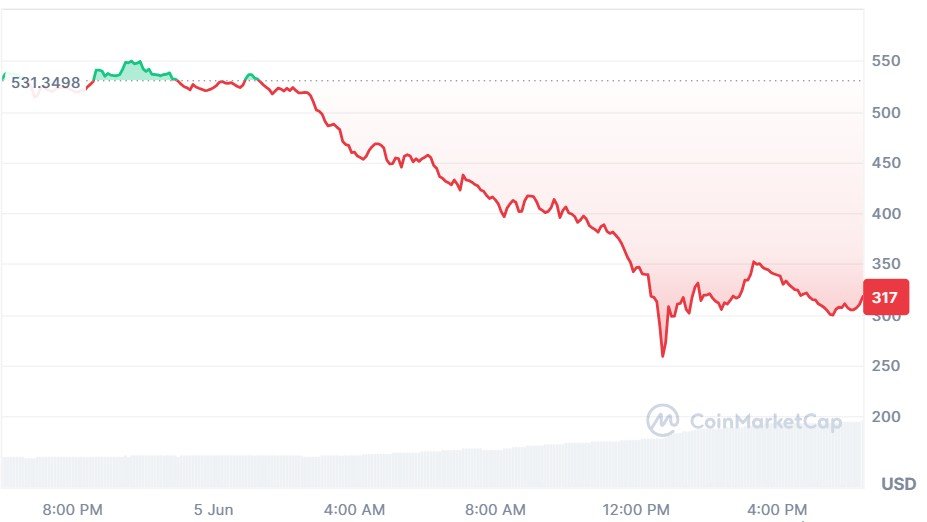
The privacy token ZEC plunged after Shielded Labs disclosed a critical flaw in Zcash’s Orchard shielded pool. The bug could theoretically have allowed undetectable counterfeit ZEC minting and had existed since Orchard’s activation in 2022, according to the disclosure.
The vulnerability has now been patched.
But the market reaction shows the harder problem: investors cannot easily prove whether the flaw was ever exploited. That uncertainty hit ZEC first, then spilled into broader altcoin risk, particularly assets where trust depends on complex cryptography and opaque supply verification.
ZEC fell more than 40% after the disclosure. Shielded Labs has proposed an upgrade that would allow verification of the privacy coin’s supply, an attempt to restore confidence after the incident.
Bitcoin was not directly affected by the Zcash bug.
Still, in fragile markets, unrelated shocks often become liquidity events. Traders sell what they can, not only what caused the stress.
That dynamic was visible in derivatives markets.
Ryan Lee, Chief Analyst at Bitget Research, said the decline was driven by a broad risk-off move across global markets that triggered “the largest crypto liquidation event since January 2026,” with about $1.8 billion in leveraged positions wiped out over the past 24 hours.
“U.S. equities declined, oil remained elevated near $95-$97 per barrel due to geopolitical concerns, and investors continued to scale back expectations for near-term Federal Reserve easing,” Lee said. “The shift in sentiment pushed Bitcoin into the low $60,000 range and Ether toward $1,800.”
The scale of liquidations mattered more than the headline price move.
More than $1.5 billion of the liquidations came from long positions, according to Lee, showing how much bullish leverage had accumulated before the selloff. Open interest fell sharply, while funding rates turned negative as traders were forced out of crowded positions.
“The speed of the move suggests market structure was the primary driver of the selloff,” Lee said.
That makes this decline different from a simple spot-market retreat.
Macro conditions created the spark. Leverage supplied the fuel. Once Bitcoin broke lower, futures positions were closed automatically, deepening the move and pushing prices through levels that discretionary traders were watching.
“Macro conditions created the catalyst, but leverage amplified the decline,” Lee said. “Similar episodes over the past two years have occurred when crowded positioning met an external shock, creating rapid liquidations across futures markets.”
The external shock is not only crypto-specific.
Global markets are again trading around oil, inflation and geopolitical risk. Brent crude remained near $95 a barrel on Friday, while WTI traded above $92, as markets assessed Middle East tensions, Iran-related negotiations and supply disruption risks around the Strait of Hormuz.
Those pressures are feeding into the Federal Reserve debate.
Higher oil prices make inflation harder to bring down. That reduces the case for rapid rate cuts and raises the cost of holding long-duration, speculative assets. Bitcoin has increasingly behaved like a high-beta macro asset during periods of funding stress, even when some investors still describe it as an inflation hedge.
That explains the uncomfortable market signal.
Bitcoin can trade with gold when investors worry about currency debasement or inflation. It can also trade like technology stocks when liquidity tightens. In the latest selloff, the second impulse dominated.
ETF flows added another layer of pressure.
U.S. spot Bitcoin ETFs had seen 13 straight sessions of outflows totaling roughly $4.4 billion before recording a small $3.05 million inflow on Thursday, according to CoinDesk. Total Bitcoin ETF holdings were down about 7.2% from their October 2025 peak to 1.28 million BTC.
It’s crucial because ETFs have become one of Bitcoin’s key marginal buyers.
When ETF demand is strong, it can offset selling from miners, traders and early holders. When ETF demand weakens, Bitcoin becomes more dependent on spot buyers and corporate treasuries to absorb supply.
That is why Strategy’s Bitcoin sale unnerved the market.
Strategy, the largest corporate holder of Bitcoin, sold 32 BTC between May 26 and May 31 at an average price of $77,135, raising about $2.5 million net of expenses and fees. The company said it still held nearly 844,000 BTC, with an average purchase price of $75,699.
The sale was tiny compared with Strategy’s overall holdings. But symbolically, it sent negative messege in the matket.
Saylor had spent years positioning Strategy as a permanent Bitcoin accumulator. Even a small sale created questions over whether the company’s financing model, preferred dividends and debt-linked obligations could force more disposals if market conditions deteriorate.
The sale contributed to market anxiety, even though the amount sold was immaterial relative to Strategy’s balance sheet.
However, Standard Chartered’s Geoffrey Kendrick maintained a $100,000 year-end Bitcoin forecast despite the “painful” week.
So, did Strategy’s sale cause Bitcoin’s decline?
Not by itself.
It’d be better to say that it became a psychological accelerant. The market was already dealing with ETF outflows, macro stress, weak liquidity and a derivatives flush. Strategy’s sale challenged one of the market’s strongest narratives: that the largest corporate Bitcoin holder would never sell.
That was enough to worsen sentiment.
Saylor views the broader decline as a capital rotation toward artificial intelligence rather than a fundamental rejection of Bitcoin. The Wall Street Journal reported that he described the slump as investors redirecting funds toward AI opportunities.
That rotation is visible across markets.
Equities tied to artificial intelligence have continued to draw capital, while crypto has struggled to rebuild momentum after its 2025 peak. Bitcoin’s underperformance against major equity benchmarks this year has made the asset more vulnerable to redemptions from institutions that entered through ETFs.
The immediate technical focus is now $61,000.
A hold above that level could allow a short-term rebound toward $62,500 or $64,000, especially after the forced liquidation of crowded long positions. CoinDesk analysts described the recent rebound toward $64,000 as an oversold bounce rather than confirmation of a trend reversal.
A break below $61,000 would be more serious.
It would put the $60,000 area in focus and could open the path toward $55,000 if macro data disappoints, ETF outflows resume, or traders rebuild short exposure. Friday’s U.S. nonfarm payrolls report is therefore important because it will shape expectations for Fed policy.
A strong jobs report may reinforce the higher-for-longer rate narrative.
A weak report could cut two ways. It may support rate-cut expectations, which could help risk assets. But it could also deepen concerns about growth, encouraging investors to reduce exposure to volatile assets.
For now, Lee argues that the main signal is the leverage reset.
“The key signal is not the decline in asset prices but the scale of leverage removed from the system,” he said. “With speculative positioning reduced and open interest resetting, markets are likely to become increasingly driven by spot demand, ETF flows, and macroeconomic developments rather than derivatives-led momentum.”
That is the central question for Bitcoin after the crash.
If spot demand returns and ETF flows stabilize, the selloff may become another leverage-clearing event in a longer cycle. If institutional outflows persist and macro pressure intensifies, Bitcoin’s fall from its October peak could become a deeper repricing of the post-ETF bull market.
The above article “Bitcoin Slumps Toward $61,000 as Zcash Bug, ETF Outflows and Strategy Sale Deepen Crypto Rout” was first published on AlexaBlockchain. Read the complete article here: https://alexablockchain.com/bitcoin-slumps-toward-61000-zcash-bug-etf-outflows-strategy-sale-deepen-crypto-rout/
Read Also: Is India Moving From Crypto Uncertainty Toward a Clearer Policy Framework?
Disclaimer: The information provided on AlexaBlockchain is for informational purposes only and does not constitute financial advice. Read complete disclaimer here.