



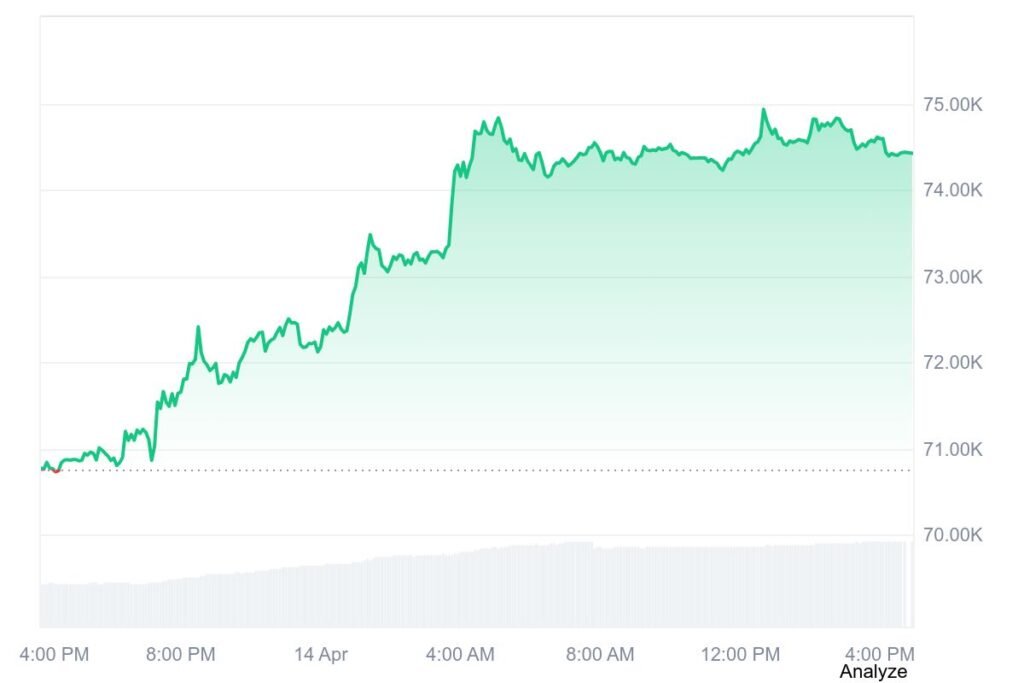
Bitcoin climbed toward the $75,000 level on Tuesday, extending a sharp rebound even as markets continued to wrestle with an oil shock, fragile U.S.-Iran diplomacy and renewed questions about how digital assets behave when inflation risks rise again.
Bitcoin was trading at about $74,442 at the time of writing, up over 5% in last 24 hours, after touching an intraday high of $74,930, as per BTC data from CoinMarketCap.
The move stood out because the macro backdrop was not friendly.
Markets have been trying to absorb the fallout from the conflict involving Iran, including disrupted shipping and tighter energy supplies linked to the Strait of Hormuz. Reuters reported on Tuesday that investors were clinging to hopes of a diplomatic breakthrough even as the U.S. blockade of Iranian ports took effect, with oil retreating from recent highs and broader risk assets rebounding.
It’s crucial for Bitcoin because higher oil prices feed directly into the inflation debate.
Brent crude had surged above $100 earlier this week before easing back below that mark as hopes for renewed talks resurfaced. Market remains highly sensitive to the risk of prolonged disruption around Hormuz, through which roughly one-fifth of global oil and gas exports normally pass.
For risk assets, the logic is simple.
If energy costs stay high, inflation can remain sticky. If inflation stays sticky, central banks may keep rates elevated for longer. That usually weighs on liquidity-sensitive assets, including crypto.
HSBC Chair Brendan Nelson said Tuesday that a peace deal in the Middle East is needed to restore global energy flows, warning that extended disruption could raise inflation and slow growth.
Yet Bitcoin is not trading like a market under full macro stress.
Instead, it is behaving like an asset with a deeper structural bid. That is the more important signal in Tuesday’s move. The rally suggests that institutional demand, short-covering and spot accumulation are, for now, offsetting the drag from inflation fears and geopolitical uncertainty.
Exchange-traded fund flows remain a key part of that story.
Data from Farside Investors show U.S. spot Bitcoin ETFs took in $358.1 million on April 9 and another $256.7 million on April 10, after mixed flows earlier in the week.
While the latest daily figures turned less uniform, the broader pattern still points to institutional money remaining active near current price levels rather than stepping away entirely.
That makes Morgan Stanley’s latest push into the market notable.
In January, Morgan Stanley filed for Bitcoin and Solana ETFs, a sign that large U.S. financial institutions were moving beyond advisory exposure and deeper into listed crypto products. Then, on April 8, Morgan Stanley Investment Management said it had launched the Morgan Stanley Bitcoin Trust, trading under the ticker MSBT on NYSE Arca.
The launch is significant beyond the product itself.
It shows how Bitcoin is being pulled further inside traditional financial distribution networks. The Morgan Stanley filing and launch suggest crypto exposure is no longer confined to specialist asset managers and crypto-native platforms. It is increasingly being packaged inside the familiar structures that wealth managers, advisors and institutional allocators already use.
That is one reason Bitcoin’s rebound carries more weight than a simple relief bounce.
The market is now being shaped by a broader investor base than in prior cycles. When that capital comes through ETFs and other regulated vehicles, it can make Bitcoin look less like a purely speculative instrument and more like a portfolio asset that institutions are willing to hold through macro volatility. That does not remove the asset’s swings. It changes who is willing to buy them.
Ryan Lee, chief analyst at Bitget Research, told AlexaBlockchain that markets are primarily pricing rising inflation expectations and delayed rate cuts as the dominant macro risk, driven by oil supply disruption following failed U.S.-Iran talks and broader changes in petroleum supply chains.
Lee said Bitcoin’s weaker performance during the oil spike pointed more to controlled deleveraging than a broad flight from risk, with ETF and institutional spot flows still providing support.
He added that Bitcoin had been consolidating in a roughly $70,000 to $74,500 range while absorbing the volatility in oil.
That reading broadly matches the market sentiment.
Oil prices were falling again on Tuesday as hopes for peace negotiations resurfaced, helping shares recover. At the same time, gold rose more than 1%, showing that investors are still looking for defensive exposure even as some appetite for risk returns
Bitcoin’s role in that environment remains more complicated than either side of the debate often suggests.
It is not behaving exactly like gold. Nor is it trading like a typical growth asset that must fall whenever inflation risks rise.
What Tuesday’s move shows is that Bitcoin is starting to occupy a hybrid position in global markets: part macro-sensitive risk asset, part alternative store-of-value trade, and part institutionally sponsored portfolio exposure.
Ignacio Aguirre, chief marketing officer at Bitget, described the latest rise as a relief move fueled by geopolitical uncertainty, short liquidations and continued ETF and spot demand.
He said Bitcoin’s climb toward $74,000 was being supported by investors who increasingly view it as a long-term store of value less tied to traditional risk-off behavior, though he added that volatility remains high as the market tests the $75,000 area.
That warning should not be ignored.
Bitcoin may be holding up better than many risk assets would in this kind of environment, but the macro risk has not disappeared.
Market is still trying to assess whether the recent easing in oil will hold or whether renewed disruption in the Gulf could send prices higher again. If that happens, the inflation narrative could quickly harden and pressure crypto alongside equities.
There is also a second theme hanging over the market, even if it is not driving price today.
Google researchers published a white paper on March 30 arguing that future quantum computers may be able to break the elliptic-curve cryptography used across many cryptocurrency systems with fewer resources than earlier estimates suggested. The paper says the threat is manageable, but it argues that the margin for upgrading major systems is narrower than many had assumed.
That has revived discussion about Bitcoin’s eventual transition to post-quantum protections.
The issue is not immediate, but it is strategically important. Any meaningful shift to quantum-resistant cryptography would require broad coordination across the Bitcoin ecosystem, including developers, wallet providers, infrastructure operators and users. That makes the debate less about imminent danger and more about governance, migration and long-term resilience.
For now, though, the market is focused on nearer-term forces.
ETF demand remains sturdy enough to matter. Oil has eased, but not enough to remove the inflation risk. And geopolitics still sit at the center of the macro picture. Against that backdrop, Bitcoin’s rebound toward $75,000 suggests buyers are still willing to treat weakness as an entry point rather than a warning sign
That may be the clearest takeaway from Tuesday’s trade.
Bitcoin is no longer moving only on crypto-native momentum. It is increasingly being repriced by the same forces that drive the rest of global markets, from war risk and energy supply to institutional product launches and cross-asset positioning. The difference now is that it has a larger pool of structural buyers underneath it. And, at least for the moment, that bid is proving strong enough to absorb the noise.
The article “Can Bitcoin Hold Near $75,000 as ETF Buying Counters Oil Shock and Iran Risk?” was first published on AlexaBlockchain. Read the complete article here: https://alexablockchain.com/can-bitcoin-hold-near-75000-as-etf-buying-counters-oil-shock-iran-risk/
Read Also: MoneyGram, Pairpoint and eToro Back Midnight’s Privacy Blockchain Before Mainnet
Disclaimer: The information provided on AlexaBlockchain is for informational purposes only and does not constitute financial advice. Read complete disclaimer here.
Image Credits: Shutterstock, Canva, Wiki Commons