



- Falcon Finance is opening a regulated tokenization pipeline in El Salvador with a GPU-backed forward anchored by compute demand from NEAR AI.
- The structure aims to finance the months between GPU purchase and deployment, before using hardware lease income to service the debt.
- Falcon wants the instrument to trade onchain, testing whether tokenization can bring secondary liquidity to the rapidly growing AI infrastructure credit market.
Falcon Finance is moving into AI infrastructure financing with a tokenized debt instrument designed to fund GPUs before they reach the data center.
The company said Tuesday it is opening a regulated issuance pipeline in El Salvador, with its first transaction structured around high-end GPUs and anchor compute demand from NEAR AI. The instrument is still being structured, meaning investors are not yet buying an operating GPU-backed product.
The move comes as Wall Street is racing to turn AI computing infrastructure into a financeable asset class. Nvidia this month outlined a $500 billion infrastructure financing initiative involving firms including Goldman Sachs, Apollo and Blackstone. The leading chipmaker seeks to bring more third-party capital into the AI buildout.
Financing the Wait Before GPUs Produce Revenue
Falcon’s structure targets a specific cash-flow mismatch in buying AI hardware.
Companies acquiring high-end GPUs can commit capital months before the equipment is delivered, installed and generating revenue. Falcon said the first transaction involves equipment whose purchase price has been fixed through October, with proceeds from the issuance funding delivery.
The debt obligation will sit inside a special purpose vehicle holding contractual rights linked to the hardware and its output, according to the company.
During the period before installation, the obligation would be issued below par and gradually accrete toward its face value. Once the GPUs are installed in a data center, lease income generated by the hardware is intended to service the debt.
That effectively gives investors exposure to two stages of the GPU lifecycle: the financing period before deployment and the cash flow generated after the equipment begins operating.
“Between paying for high-end GPUs and racking them, four to eight months go by with the capital already committed and nothing running,” Yurii Olentyr, a board member at GPU supplier vGPU, said in a statement shared with AlexaBlockchain. “Today that gap sits on somebody’s balance sheet, or with a small group of lenders who understand the hardware well enough to take the risk. The constraint we see is almost never demand for compute but rather who can afford to wait.”
More From AlexaBlockchain
NEAR AI Provides Anchor Demand
NEAR AI will provide anchor demand for the computing capacity produced by the equipment and serve as a technology partner, according to Falcon.
The company was founded by Illia Polosukhin, previously a Google researcher and one of the eight authors of the 2017 paper Attention Is All You Need. That research introduced the Transformer architecture that became foundational to modern large language models.
Having a buyer for the resulting compute could be important to the financing structure because GPU economics ultimately depend on utilization and rental pricing, not simply the resale value of the chips.
That distinction has become increasingly relevant as billions of dollars flow into GPU-backed lending.
GPU-Backed Debt Is Already Becoming Big Business
Falcon is not the first company to finance GPUs as productive assets.
CoreWeave pioneered large-scale borrowing against AI computing infrastructure and in March closed an $8.5 billion GPU-backed financing facility, which the company described as the first such transaction to receive an investment-grade rating.
The market is now moving another step toward financialization.
CME Group, Silicon Data and trading firm DRW are preparing compute futures designed to allow customers to hedge the price of GPU computing capacity, according to Barron’s. The planned contracts, subject to regulatory approval, would create a standardized financial market around the price of compute rather than ownership of individual machines.
Falcon’s proposal attacks a different part of the problem. Rather than creating a derivative tied principally to compute pricing, it aims to finance identified hardware and then connect that obligation to the revenue the equipment generates.
Turning Private GPU Credit Into Tradable Paper
The more unusual part of the structure is what Falcon intends to do after underwriting.
GPU financing has largely remained in private-credit arrangements and bespoke lending facilities, where positions can be difficult to sell before maturity. Falcon wants the resulting obligation to exist as an onchain asset capable of secondary trading and potentially being used as collateral.
“Compute financing has become one of the fastest-growing categories in asset-backed credit, and almost all of it is arranged through private syndicates,” Artem Tolkachev, Falcon Finance’s chief RWA officer, said.
“A lender who wants out before maturity has very few options. We are structuring a tokenized GPU forward so that the exposure can be transferred on a secondary market and posted as collateral against borrowing.”
The underlying credit risks, however, do not disappear because the obligation has been tokenized.
Investors remain exposed to hardware delivery, counterparty performance, GPU utilization, lease pricing and technological depreciation. Those risks are particularly important in AI infrastructure because new chip generations can alter the economics of existing hardware quickly.
Why El Salvador Matters
Falcon is using El Salvador because the country has built a dedicated regulatory framework for issuing and servicing digital assets.
Its Digital Assets Law was approved in 2023, while the National Commission of Digital Assets, or CNAD, oversees the country’s digital-asset ecosystem and maintains rules covering issuers and digital-asset service providers.
Falcon said issuance in the country will be handled through NOTA S.A.S. de C.V., which it identified as registered under number PSAD-0088. CNAD’s public registry currently lists NOTE S.A.S DE C.V. under PSAD-0088, registered on June 12, 2026, with activities including digital-asset trading and derivative-related services. The difference in the company name appears in the source materials and should be clarified by Falcon.
The regulatory model is intended to separate primary issuance from subsequent trading. Falcon says minting and redemption would remain subject to identification and compliance requirements while tokens could subsequently circulate through open blockchain markets, including decentralized exchanges.
Whether that produces meaningful secondary liquidity remains untested.
Tokenization Hasn’t Automatically Created Liquidity
That question matters because the tokenized real-world asset market has expanded much faster than secondary trading in many of its assets.
As per RWA.xyz data, there is $38.21 billion worth of tokenized assets onchain as of Aug. 18, excluding stablecoins under its principal asset-value measure.
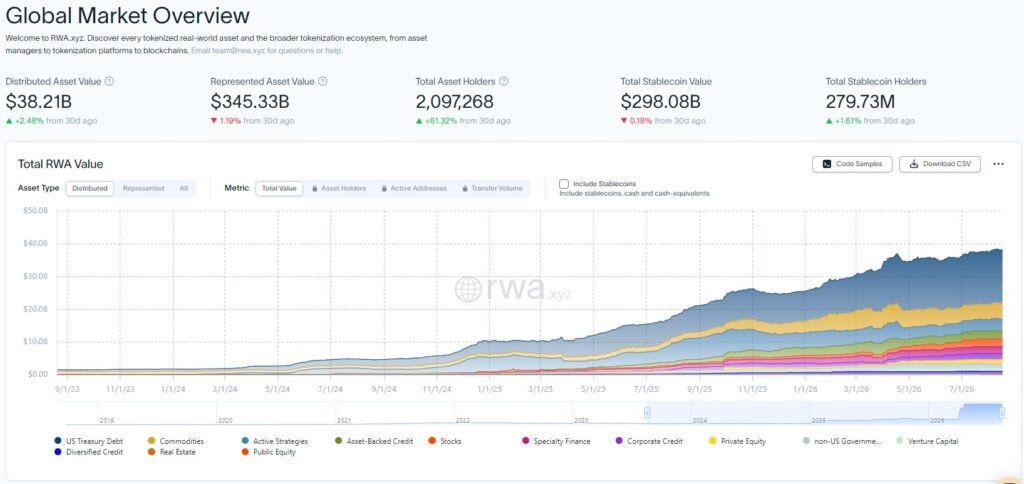
Academic research examining tokenized Treasuries, gold and private credit has nevertheless found that putting an asset onchain does not itself guarantee an active market. Trading activity and holder participation vary substantially across products, with some relatively large tokenized assets remaining thinly traded or concentrated among relatively few holders.
Falcon says its architecture is specifically intended to tackle that problem by designing assets for secondary markets and collateral use from inception rather than treating tokenization simply as a new ownership record.
“Most issuers do not want tokenization. They want a result: liquidity, composability, and capital they can actually use,” Falcon founding partner Andrei Grachev said. “Wrapping an asset in a token is the easy part, and on its own it changes nothing.”
Why Does It Matter?
AI’s infrastructure boom has a financing problem as well as a technology problem.
GPUs are expensive, delivery and data-center deployment require substantial upfront capital, and the revenue backing those investments begins only after the machines become operational. Nvidia’s attempt to mobilize hundreds of billions of dollars of outside capital and CoreWeave’s repeated use of GPU-backed debt show how quickly computing hardware is being turned into collateral for a new credit market.
Falcon is testing whether blockchain markets can provide another source of capital — and, importantly, whether those credit exposures can become transferable rather than remaining locked inside private lending agreements.
El Salvador already has precedent for regulated tokenized assets. Tether’s gold token XAU₮ is issued through an El Salvador entity registered as a stablecoin issuer and digital-asset service provider under the country’s Digital Asset Issuance Law.
But Falcon’s GPU structure will face a harder test than simply putting debt onchain.
Its significance will depend on whether investors actually trade the instrument after issuance, whether it can reliably function as collateral, and whether compute revenue continues to cover financing obligations as newer generations of AI hardware arrive.
If those pieces work, GPU financing could begin moving from bespoke private-credit deals toward a more standardized market for investable AI infrastructure.
The above article “Falcon Finance Turns the Wait for AI GPUs Into a Tradable Investment” was first published on AlexaBlockchain. Read the complete article here: https://alexablockchain.com/falcon-finance-turns-the-wait-for-ai-gpus-into-a-tradable-investment/
Read Also: This is the First U.S.-Chartered Depository Bank to Offer Stablecoin Invoicing
Disclaimer: The information provided on AlexaBlockchain is for informational purposes only and does not constitute financial advice. Read complete disclaimer here.