



- Spacecoin has launched SpaceRouter, a residential proxy platform for AI agents that uses real home internet connections.
- The product is designed to help agents avoid blocks triggered by datacenter-originated traffic.
- SpaceRouter supports HTTP and SOCKS5, geographic targeting, and standard proxy-based integration.
AI agents may be getting smarter, but many still cannot move freely across the open web. Spacecoin’s launch of SpaceRouter suggests that internet access, not model capability alone, is becoming a critical constraint on the next phase of agent deployment.
Spacecoin has launched SpaceRouter, a residential proxy platform designed to help AI agents access websites through home internet connections instead of data-center infrastructure.
The product is aimed at an important problem: many websites treat traffic from cloud servers as suspicious, making it harder for autonomous agents to browse pages, gather data, and complete tasks across the public web.
The launch says something larger about where the AI market is heading.
For much of the past two years, the focus in AI has been on models, chips, and applications. But as agents move from chat interfaces into software that actually clicks, searches, and executes workflows online, the constraint is shifting.
In many cases, the issue is no longer whether the model can reason through a task. It is whether the internet will let the agent complete it.
SpaceRouter is built around that friction point.
How SpaceRouter Works? It routes agent traffic through real residential connections, with developers able to plug it into existing systems through standard proxy settings rather than redesigning their workflows from scratch.
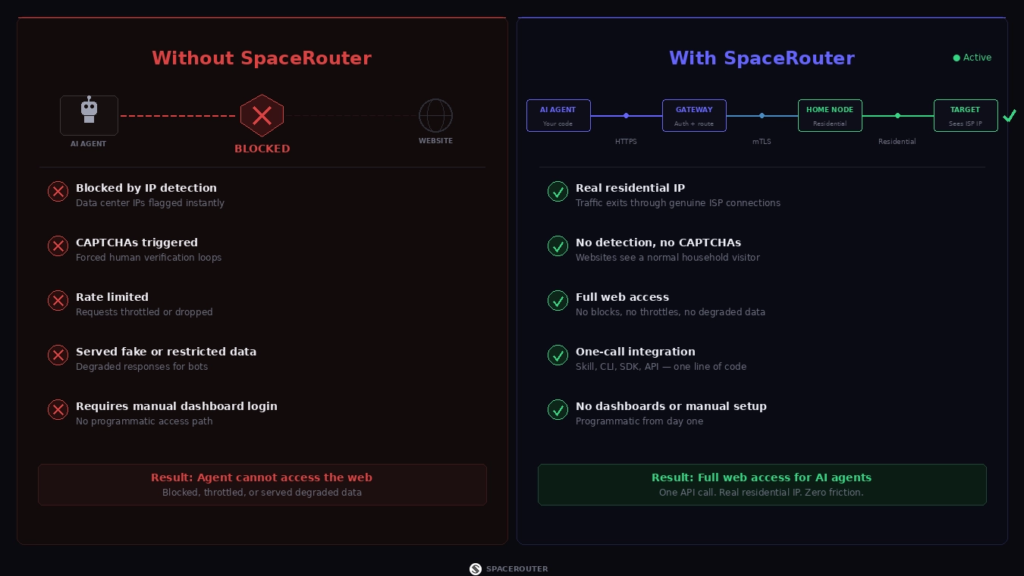
The platform supports HTTP and SOCKS5 protocols, geographic routing, and standardized integrations meant for developers working in common agent environments.
It’s crucial because anti-bot systems have become more sophisticated.
In 2024, Cloudflare, one of the largest bot-management providers, introduced machine-learning models to detect abuse coming through residential proxies.
In a later 2025 post, the company said it was expanding into per-customer behavioral anomaly detection to catch bots that try to mimic normal traffic over time.
That suggests the web’s trust systems are no longer just screening for obvious server-originated automation. They are increasingly trying to identify more subtle and persistent forms of non-human activity.
That creates an arms race.
As more businesses deploy AI agents for research, e-commerce, operations, and web automation, developers need ways to keep those systems functioning on sites built to resist automated access.
Residential routing does not solve everything. Websites also examine browser fingerprints, session behavior, request timing, and other signals. But IP reputation remains one of the first filters many systems apply, which makes residential infrastructure commercially valuable for anyone trying to keep agents online. This is an inference based on Cloudflare’s detection focus and SpaceRouter’s positioning around residential traffic.
Spacecoin’s move also broadens its own story.
The company has mostly been associated with decentralized connectivity and satellite-based internet ambitions. In October 2025, Spacecoin successfully transmitted secure data through space using blockchain technology as part of its effort to build a decentralized alternative to traditional internet infrastructure in underserved or censored markets. TechCrunch described this achievement of Spacecoin as pursuing a decentralized communications backbone that could one day compete with more centralized satellite networks.
SpaceRouter extends that infrastructure thesis from orbit to the application layer.
Instead of focusing on last-mile connectivity or satellite transmission, the new product addresses a different question: how autonomous software systems can reliably move through today’s internet. In that sense, the launch looks like an attempt to position Spacecoin as a provider of AI-era network infrastructure, especially for developers who see web access as a core part of agent execution. That interpretation is based on the contrast between Spacecoin’s earlier connectivity strategy and the new product’s developer-facing design.
There is also a strategic tension embedded in the market.
Residential proxies are useful because they make traffic appear closer to ordinary consumer browsing. But that same feature has made them a recurring focus for security vendors trying to detect abuse.
According to Cloudflare, bot operators have increasingly used residential proxy networks, forcing defenders to invest in machine learning and behavioral analysis rather than simple IP blocking.
That means products like SpaceRouter may sit in an uncomfortable middle ground: legitimate tools for AI workflows on one hand, and part of a broader automation-versus-defense contest on the other.
Why does it matter? The launch of SpaceRouter highlights that the next stage of AI adoption may depend on infrastructure below the model layer.
If agents are expected to navigate the public internet the way humans do, then access continuity, network reputation, and compatibility with site-level trust systems could become foundational components of the stack. Spacecoin’s launch shows that for agent developers, the problem is no longer just intelligence. It is operability.
That may be the clearest signal from SpaceRouter’s launch.
The web was built around the assumption that human users sit behind browsers and household connections. AI agents challenge that assumption. Spacecoin is betting that a new class of infrastructure can bridge the gap. Whether that becomes a durable market may depend on what happens next: whether websites begin accommodating verified agents more formally, or whether anti-bot systems evolve even faster in response. Either way, the launch points to a growing reality for the AI industry. Smarter agents alone are not enough if they cannot get through the front door.
The article “Can AI Agents Scale on a Web Built to Block Them? Spacecoin Thinks Residential Routing Is the Answer” was first published on AlexaBlockchain. Read the complete article here: https://alexablockchain.com/spacecoin-spacerouter-residential-proxy-platform-for-ai-agents/
Read Also: MoneyGram, Pairpoint and eToro Back Midnight’s Privacy Blockchain Before Mainnet
Disclaimer: The information provided on AlexaBlockchain is for informational purposes only and does not constitute financial advice. Read complete disclaimer here.
Image Credits: Spacecoin, Shutterstock, Canva, Wiki Commons