







Social trading promises to make markets easier by letting ordinary users follow people who appear to know what they are doing.
New research from DWF Ventures suggests that dynamic may work far better for the people being followed than for those copying them.
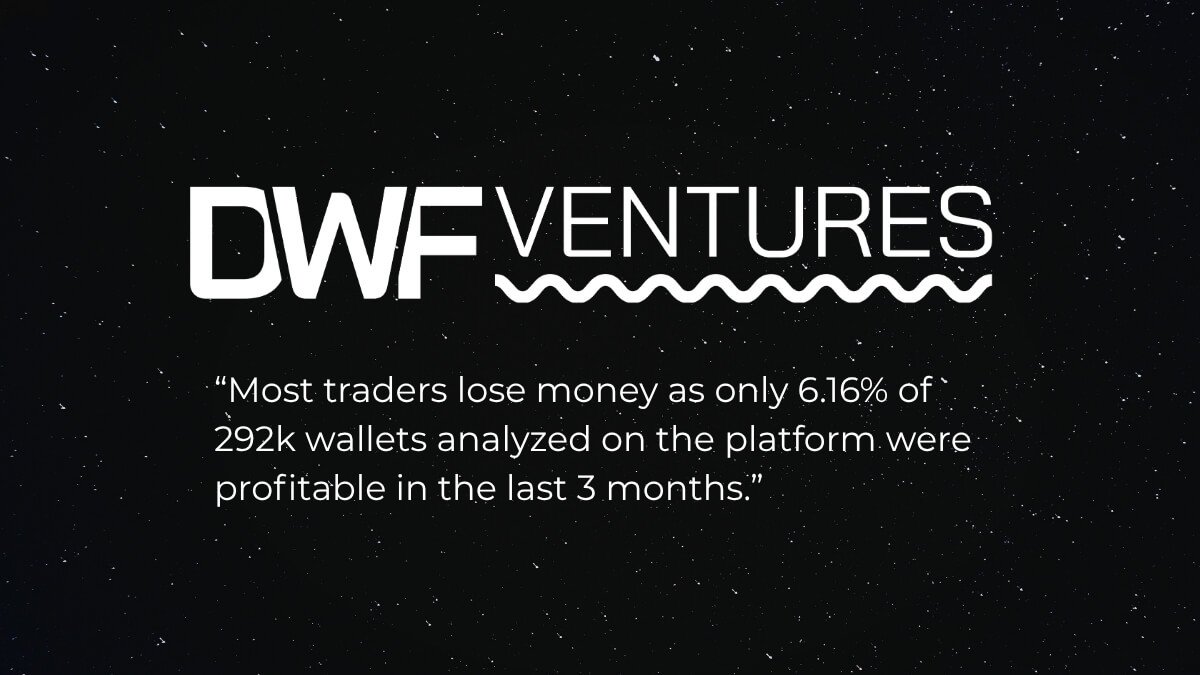
Only 6.16% of roughly 292,000 wallets analyzed on Fomo were profitable over a 90-day period, based on realized profits, according to research from DWF Ventures, the venture-capital arm of crypto market maker DWF Labs.
The distribution was even more concentrated at the top.
Among profitable wallets, just 25 generated more than $10,000 in net realized profit, according to the analysis.
The findings raise a harder question for the rapidly expanding social-trading industry: What happens when the act of following a successful trader changes the market that followers are trying to profit from?
Followers Can Move the Trade Against Themselves
DWF Ventures argues that social trading contains a structural feedback loop.
A trader establishes a reputation by making successful public calls. More users then follow that trader, increasing the amount of capital responding to the next call.
That additional buying can itself push prices higher.
“The flywheel growth effect is a double-edged sword,” DWF Ventures wrote in the research. Traders can build reputations from public calls that become partly self-fulfilling as followers move into the same positions.
That mechanism becomes particularly important in thinly traded crypto assets.
If a prominent account buys a relatively illiquid token before its followers, subsequent purchases can push the price higher. The original trader therefore has a better entry price than the people trying to replicate the trade.
When that trader sells, followers may effectively provide the liquidity needed for the exit.
DWF describes this as a potential “exit liquidity” problem. But the data does not establish that popular traders intentionally trade against followers, and losses alone should not be interpreted as evidence of manipulation.
The more fundamental issue is execution asymmetry.
Even when every transaction is legitimate, a follower receiving a signal seconds or minutes later is not necessarily copying the same economic trade. The token price, liquidity and risk-reward profile may already have changed.
More From AlexaBlockchain
Transparency Doesn’t Necessarily Remove the Information Gap
Blockchain-based social trading was supposed to solve one of the traditional industry’s biggest problems: unverifiable performance claims.
Onchain positions can theoretically be inspected rather than taken on trust.
Fomo itself markets social trading around seeing what friends and prominent traders are buying in real time. Its app also provides profit tracking, leaderboards and rapid trading across supported blockchain networks.
Yet DWF Ventures argues that wallet transparency creates its own limitations.
A trader can maintain another wallet that acquires a position before buying through the public wallet associated with their social identity. By the time followers see the observable transaction, the trader may already have accumulated at a lower price elsewhere.
That means verifiability can confirm what happened in one wallet without proving that the wallet represents the trader’s complete economic position.
Third-party tools have emerged specifically to link Fomo identities with blockchain addresses and let users examine holdings and transaction histories. FomoScan, for example, describes its service as a way to verify wallets before copying trades and explicitly warns that a follower’s execution price can diverge significantly in thin markets.
The distinction matters because transparency of transactions is not the same thing as transparency of incentives.
Social Trading Is Getting Easier — and Bigger
DWF’s findings come as investing platforms increasingly combine trading with features borrowed from social media.
Fomo advertises leaderboards, real-time alerts, one-click purchases and feeds showing what other traders are buying. Public listings say the service has attracted more than one million users, while its website has promoted itself as a trading application designed for a mainstream audience.
The model extends well beyond crypto.
AfterHour, an equities-focused social trading platform, says more than 200,000 investors and traders use its network, with hundreds of millions of dollars in connected portfolios and millions of trade signals sent. Users can connect brokerage accounts so other participants can see verified positions rather than screenshots or unsupported claims.
Autopilot has taken another approach by letting investors automatically replicate portfolios based on politicians, hedge funds and other public strategies. Its Pelosi Tracker originated from a social-media account tracking congressional disclosures before becoming an investable product.
The attraction is straightforward.
Social trading removes much of the research burden from the user and replaces it with a familiar decision: Who do I trust?
That can make trading accessible to people who otherwise would not participate. It also turns successful traders into distribution channels for financial products.
The Same Network Effect Can Distort Prices
The problem is that financial networks behave differently from conventional social networks.
If millions of people follow the same entertainer, watching the content does not normally make it worse for subsequent viewers.
Markets are different.
Every new participant potentially changes the price.
Research examining the 2021 GameStop episode found a significant positive relationship between Reddit discussion and subsequent trading activity. But researchers found no evidence that Reddit posts themselves contained information capable of predicting returns, underscoring the difference between attention that drives trading and information that creates investment value.
That distinction is especially consequential for small-cap tokens.
A trader with enough followers can potentially create a temporary liquidity event simply by announcing or revealing a position. Followers then compete with each other to enter before the resulting price move is exhausted.
The faster the platform becomes, the more powerful that flywheel can be.
And the person whose trade everybody is copying still has the fundamental advantage: they went first.
A Warning for Social-Trading Users
DWF Ventures’ results amount to a warning against treating transparency or a profitable leaderboard as proof that followers can reproduce the displayed performance.
The first issue is survivorship and selection bias. Users naturally gravitate toward accounts with eye-catching historical returns, although past winners may have benefited from market conditions that cannot be repeated.
The second is execution.
A copied trader’s entry price can differ materially from the follower’s fill, particularly when hundreds or thousands of accounts react to the same signal.
Third is incomplete information.
Even a verified wallet cannot necessarily reveal positions held through separate wallets, exchanges, derivatives or other accounts.
And finally, social validation can encourage users to substitute another trader’s reputation for their own investment thesis.
U.S. securities regulators have repeatedly warned investors against relying exclusively on social-media investment signals. The Securities and Exchange Commission has said social sentiment can contain inaccurate or misleading information and may encourage impulsive decisions. In a February 2026 alert, the agency again warned investors not to make investment decisions solely from recommendations received through social-media platforms or apps.
The UK’s Financial Conduct Authority also treats some automated copy-trading arrangements as portfolio or investment management, illustrating how regulators increasingly view the feature as more than simply another social-media tool.
Why Does It Matter?
Social trading could become one of the strongest distribution channels for retail investing because it combines three powerful forces: speculation, social validation and frictionless execution.
The DWF data shows why that combination deserves scrutiny.
The industry’s competitive advantage is also shifting. As trading fees converge toward zero, platforms increasingly compete through their communities, influential traders, proprietary signals and network effects rather than execution alone.
That makes the social graph economically valuable.
But it also creates a potential conflict between what maximizes platform engagement and what improves follower returns. More signals, more copying and more trading generally increase activity, even when the average participant loses money.
Retails users should interprete DWF’s 6.16% profitability figure carefully. It measures realized profits over a specific 90-day window, not lifetime investment performance. Wallets are not necessarily equivalent to individual users, and unrealized positions can alter the picture.
Still, the concentration is difficult to ignore.
If only a small minority of participating wallets are profitable while an even smaller group captures meaningful gains, social trading may be considerably better at democratizing access to trading than democratizing successful trading.
That is the central tension facing the sector.
The same network effects capable of bringing millions of new investors into markets can also leave late-arriving followers competing for increasingly expensive entries — and, in the worst case, supplying the liquidity that lets the traders they admire get out.
The above article “Only 6% of Fomo Copy Traders Made Money, DWF Study Finds” was first published on AlexaBlockchain. Read the complete article here: https://alexablockchain.com/only-6-percent-of-fomo-copy-traders-made-money-dwf-study-finds/
Read Also: This is the First U.S.-Chartered Depository Bank to Offer Stablecoin Invoicing
Disclaimer: The information provided on AlexaBlockchain is for informational purposes only and does not constitute financial advice. Read complete disclaimer here.


