








Tokenization is beginning to face a harder test than attracting assets and investors: proving the infrastructure and economics can work at scale.
A series of developments over the past week illustrates that transition. Securitize reported record tokenized assets but weaker tokenization revenue, tokenized equities surpassed 1.3 million holders, and JPMorgan disclosed larger positions in Bitcoin and Ether exchange-traded funds.
Together, the developments suggest digital assets are moving deeper into mainstream financial markets. The challenge is increasingly shifting from demonstrating demand to supporting that demand reliably and profitably.
“We have spent years asking whether there is demand for digital financial products,” Edwin Mata, CEO and co-founder of tokenization platform Brickken, said in comment provided to AlexaBlockchain. “I think the more important question now is whether we have built the infrastructure to support that demand properly.”
Securitize Highlights the Economics Problem
Securitize offered perhaps the clearest example of the tension between adoption and economics.
The BlackRock-backed tokenization company reported average tokenized AUM of a record $4.3 billion during the Q2, up 16% from a year earlier. Transaction volume increased 170% to $5.3 billion.
Securitize became a publicly traded company on July 2, 2026, trading on the NYSE under the ticker symbol SECZ. It completed its business combination with Cantor Equity Partners II, a SPAC sponsored by Cantor Fitzgerald, valuing Securitize at a $1.25 billion pre-money equity value and raising over $400 million in cash.
Carlos Domingo, Chairman and CEO of Securitize, said during the Q2 earning call on 13 August 2026 that the firm reached $5 billion AUM milestone (early Q3).
The company’s financial performance moved in the opposite direction.
Quarterly revenue declined 5% from a year earlier to $14.4 million, while Securitize recorded a net loss of $21.7 million compared with a $6.1 million loss a year earlier. Its shares fell 21% in after-hours trading following the earnings report.
The divergence does not mean tokenization itself has poor economics.
It does, however, highlight an important distinction. Growth in assets represented onchain does not automatically generate proportional revenue or profits for the companies supplying the infrastructure.
For providers, the commercial question becomes more important as tokenization moves beyond pilots.
Historically, many deployments have required integrations, regulatory structuring and technology configured around individual issuers. Such an approach is workable when volumes are small, but becomes harder to sustain when institutions launch multiple products across jurisdictions.
“Tokenization will ultimately be judged on what stays live and keeps operating,” Mata said. “If every new deployment requires another custom project, it becomes very difficult to build a market that genuinely scales.”
Mata argues that the industry will increasingly need a Tokenization-as-a-Service model, where common infrastructure can be reused across different issuers and instruments rather than rebuilt for each deployment.
That would shift the economic model closer to enterprise software: recurring infrastructure supporting assets throughout their lifecycle, rather than primarily earning revenue when an asset is initially issued.
Tokenized Stocks Are Starting to Find Users
The demand side of the market, meanwhile, is growing rapidly.
Tokenized-stock holders increased 92.61% over the past 30 days to about 1.33 million, according to RWA.xyz data. Monthly transfer volume climbed 194.73% to $23.49 billion, while monthly active addresses increased 41.60% to almost 601,623.

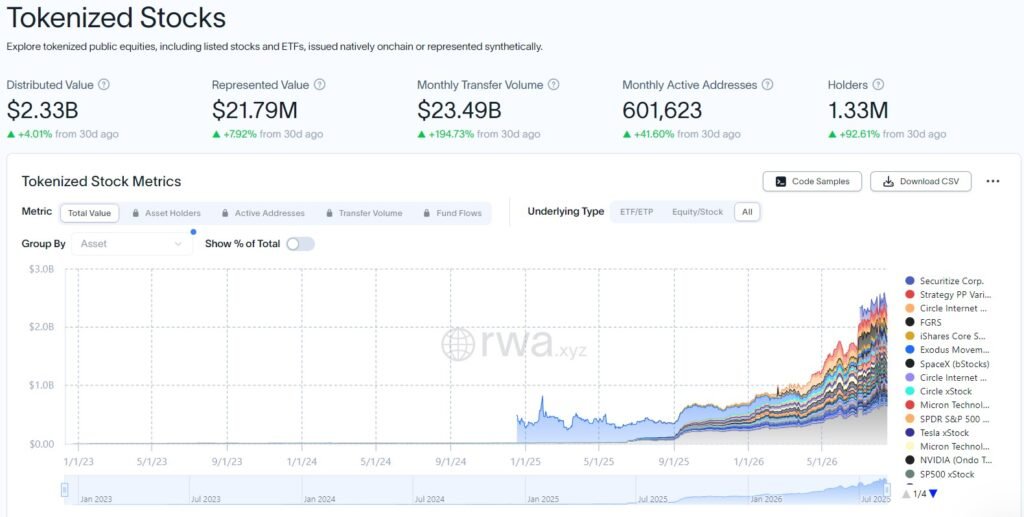
The total distributed value of tokenized stocks increased more modestly, rising 4.01% to approximately $2.33 billion.
As on 17 August 2026, Ondo leads the total tokenized stocks market with $873 million, followed by Kraken’s xStocks at $555.9 million and Binance’s bStocks at $480.8 million.
The numbers suggest tokenized equities are developing an audience beyond small-scale experiments.
Yet a larger user base also increases the operational burden.
Creating a blockchain representation of a stock is only the starting point. Platforms still need to handle ownership rights, custody, compliance restrictions, distributions, corporate actions and secondary transfers.
The underlying asset must also actually be available.
That problem became particularly visible during SpaceX’s June initial public offering.
Binance Wallet, Bybit and Bitget Wallet canceled tokenized SpaceX offerings and refunded customers after xStocks was unable to provide enough underlying shares. The campaigns had collectively attracted more than $1 billion in demand before the supply shortage became apparent.
The blockchain was not the principal constraint. Access to the underlying shares was.
The episode demonstrated an important limitation of tokenization: moving distribution onto a blockchain does not remove the structural constraints of the market underneath it.
“Reaching a million holders is a meaningful milestone,” Mata said, “but what matters over the long term is whether the infrastructure can support those people once they are actually using these assets every day.”
JPMorgan Shows Crypto Moving Into Existing Financial Infrastructure
A separate development provides another indication of how digital assets are becoming integrated into conventional finance.
JPMorgan disclosed about 10.4 million shares of BlackRock’s iShares Bitcoin Trust, or IBIT, in its Q2 13F filing. That was up roughly 25% from 8.3 million shares in Q1, with the position valued at $356 million at the end of June.
The bank’s reported position in BlackRock’s iShares Ethereum Trust increased even more sharply.
JPMorgan held 1.17 million ETHA shares at the end of the quarter, more than 4 times the 267,000 shares disclosed three months earlier.
Those figures should not be interpreted as a straightforward directional wager by JPMorgan on Bitcoin or Ether.
A Form 13F shows certain long positions held by institutional investment managers but does not reveal the complete economic exposure behind them. Holdings can be related to client activity, market-making, hedging, inventory or other institutional functions.
That distinction is important.
The more significant development may be that Bitcoin and Ether exposure increasingly appears inside the same regulated products, reporting processes and portfolio infrastructure used by major financial institutions for traditional assets.
“One of the clearest signs of institutional adoption is when digital assets stop requiring their own separate conversation and simply become another part of how financial institutions manage capital,” Mata said.
Institutional adoption does not necessarily require every major bank to become a long-term crypto investor.
It can instead mean banks custody assets, facilitate client demand, provide liquidity, manage hedges and incorporate digital-asset products into existing risk and capital-management systems.
Why It Matters: Tokenization Is Moving From Proof to Execution
The latest developments point to a tokenization market entering a more demanding stage.
The question is no longer simply whether stocks, funds and other financial instruments can be represented on blockchains. A growing number of financial firms are already demonstrating that they can.
The harder question is whether those instruments can operate reliably, compliantly and economically for years.
That requires infrastructure capable of handling identity, permissions, ownership records, regulatory restrictions, settlement, distributions and corporate actions as user numbers and transaction volumes grow.
Securitize’s results illustrate one side of that transition. Assets and transaction volumes can increase even while the economics of providing tokenization infrastructure remain under pressure.
Tokenized equities illustrate another.
The market has reached 1.33 million holders and over $23 billion in monthly transfer volume, but the SpaceX episode demonstrated that blockchain accessibility cannot compensate for failures in sourcing and maintaining the underlying asset.
JPMorgan’s filings provide a third signal.
Rather than existing exclusively within a separate crypto market, Bitcoin and Ether exposure is increasingly being handled through conventional investment vehicles and institutional reporting systems.
That changes what success looks like for tokenization companies.
The competitive advantage may increasingly come not from putting the largest number of assets onchain, but from making those assets inexpensive to launch, reliable to operate and easy to manage over their entire lifecycle.
“Tokenization becomes genuinely useful when people stop being impressed by the technology and simply expect the financial instrument to work,” Mata said. “I think that is the standard the industry is now moving towards.”
The above article “Tokenization Is Growing Fast. Now the Industry Has to Prove It Can Scale” was first published on AlexaBlockchain. Read the complete article here: https://alexablockchain.com/tokenization-growing-fast-now-industry-has-to-prove-it-can-scale/
Read Also: This is the First U.S.-Chartered Depository Bank to Offer Stablecoin Invoicing
Disclaimer: The information provided on AlexaBlockchain is for informational purposes only and does not constitute financial advice. Read complete disclaimer here.


