








Bitcoin stabilized near the mid-$78,000 range on Tuesday, February 3, after a sharp weekend sell-off briefly pushed the token below $75,000. Analysts linked the recent sell-off to thin liquidity, forced deleveraging and broader risk-off positioning across markets. At the time of writing (11 am ET), Bitcoin was trading near $77,900, while Ethereum slipped to roughly $2,300.
The move leaves Bitcoin down roughly 40% from its recent peak around $125,000, showing how quickly sentiment has shifted from late-2025 momentum to early-2026 stress testing across risk assets.
Weekend liquidity meets leverage unwind
The latest downdraft had the familiar signature of a crypto weekend: traditional markets were shut, liquidity was thinner, and crypto became one of the few “open” venues where capital could be repositioned quickly. Diego Martin, CEO of Yellow Capital, framed the price action as a liquidity-driven event rather than a fundamental repricing.
“It has certainly been a tricky few months for the digital asset market… US Spot BTC ETFs have seen strong outflows, capital is increasingly moving into AI-linked equities and precious metals, and thinning liquidity has caused disproportionately large price drops… Weekends also matter more than people admit. Digital assets are one of the few open liquid markets when others are closed, so it often becomes the source of liquidity when capital needs to be quickly repositioned,” Diego said to AlexaBlockchain.
That “repositioning” showed up in liquidation data. Around $2.56 billion worth of Bitcoin-position were liquidated as traders unwound leveraged bets amid heightened volatility. Reuters described the episode as a deleveraging move amplified by a macro shock rather than a crypto-specific failure.
Tuesday’s tape: stabilization, not relief
By Tuesday, the selling pressure had eased into a cautious consolidation. According to CoinMarketCap data, Bitcoin was trading around $77,500 with a market cap of $1.55 trillion. The 24-hour trading volume was $49.94 billion, down over 36%.

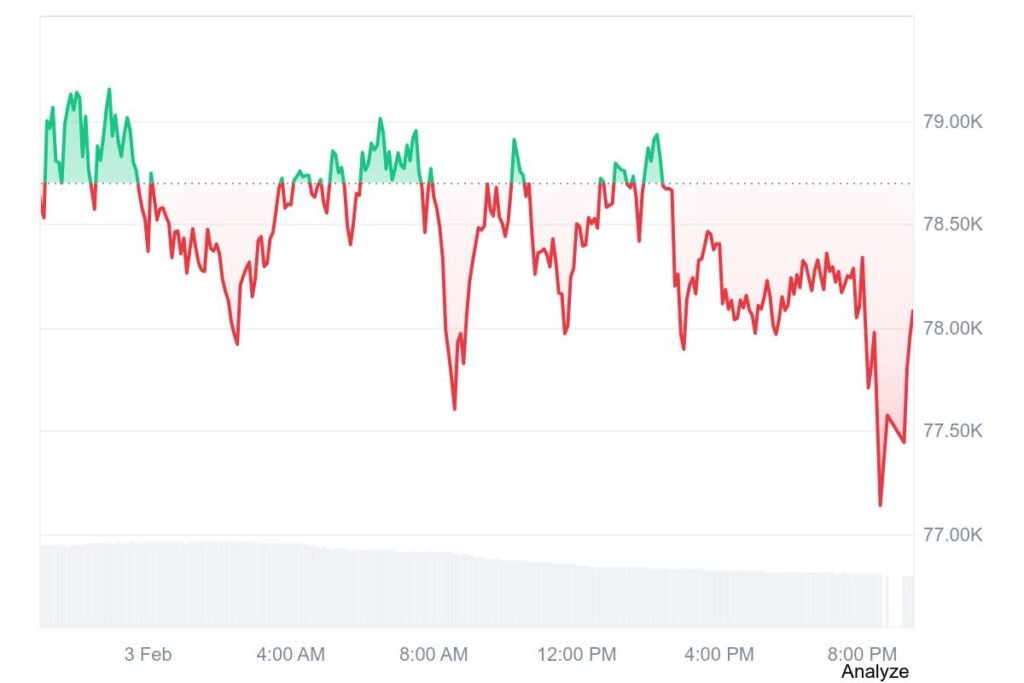
That posture is reflected in sentiment gauges. CMC Crypto Fear and Greed Index which measures the prevailing sentiment in the cryptocurrency market is currently at 17/100, squarely in “Extreme Fear” territory. Extreme Fear is often associated with mechanical selling pressure, but also with fragile, headline-sensitive rebounds.
Ryan Lee, chief analyst at Bitget, characterized the environment as “Fear, Liquidations, and a Fed Reset: Crypto’s Macro Stress Test.” In his assessment shared with AlexaBlockchain, the drawdown below $75,000 for Bitcoin and sub-$2,200 prints for Ether were driven by negative sentiment and macro-liquidity concerns that turned routine volatility into a cascade.
Lee said he expects Bitcoin to oscillate between $70,000 and $80,000 in the short term, with downside spikes possible in thin liquidity, and Ether to trade in a wide $1,800–$2,600 band.
He added that stabilization would be supported by a rebound in the Fear & Greed index above 40 and reduced liquidation volumes, while persistent outflows from spot ETFs would be a potential warning signal.
The ETF story: outflows… then a sharp reversal
One reason traders continue to watch downside tail risks is the behavior of U.S. spot Bitcoin ETFs, which have become a visible transmission channel between macro risk appetite and crypto positioning.
After a stretch of net outflows late in January—including a large risk-off day on January 30—flows reversed sharply at the start of February. Farside Investors data showed U.S. spot Bitcoin ETFs recorded about $561.8 million of net inflows on February 2, 2026, snapping a multi-session outflow run.
That reversal can cut both ways: it suggests institutional bid still exists on drawdowns, but it also highlights how quickly flows can swing when macro headlines or positioning shifts—especially when leveraged derivatives are already unstable.
Macro is back in the driver’s seat: Fed chair uncertainty and the “AI trade” wobble
While crypto narratives often oscillate between internal catalysts and idiosyncratic shocks, this week’s price action has looked more like cross-asset risk management.
Part of the market’s focus has been on the U.S. central bank. President Donald Trump’s nomination of Kevin Warsh as the next Federal Reserve chair injected uncertainty into rate expectations and the policy path, at a moment when investors were already sensitive to liquidity conditions. The current chair, Jerome Powell, is set to conclude his term in mid-May.
Separately, concern about the durability of the equity “AI trade” has spilled into broader risk sentiment. Microsoft results and commentary around large AI spend and cloud growth have fueled periodic doubts about near-term payoff. It is worth noting because rotations away from crowded equity themes can tighten overall risk budgets and raise correlations across speculative assets.
Gold’s surge: hedge demand, then profit-taking
Crypto’s drawdown also arrived as gold traded at historically elevated levels, reinforcing the “risk-off” framing. Investors booked profit after record highs in precious metals, with U.S. gold futures settling around $5,318/oz on January 28 and UBS raising its forecast trajectory while still projecting some cooling into end-2026.
In mid-Jan, Bitcoin climbed above $99,000 alongside gold on softer U.S. inflation and unease about the Fed’s independence. This shows how tightly crypto has become tethered to the same macro forces driving cross-asset positioning.
In that January episode, expectations of easier financial conditions and a weaker dollar helped lift both hedges and high-beta proxies for liquidity, allowing Bitcoin to trade in sympathy with gold’s surge. The latest move has been the mirror image: as policy uncertainty and liquidity anxieties resurfaced, the market shifted into a risk-off posture, and Bitcoin behaved less like a “digital gold” co-beneficiary and more like a leveraged risk asset—where thin weekend liquidity and forced liquidations can magnify declines even as gold remains elevated.
The key takeaway is not that gold “caused” the move, but that elevated demand for hedges and capital preservation tends to coincide with tighter liquidity for high-volatility assets—especially when leverage is high and weekend order books are thin.
Markets now appear to be in a holding pattern: not outright panic, but not a clean reset either. Key signposts traders are monitoring:
- Liquidity and leverage: whether liquidation pressure fades and funding/positioning normalizes after the weekend unwind.
- ETF flows: whether Monday’s inflow strength persists or flips back to outflows.
- Macro headlines: any further clarity on Fed leadership, rate-path expectations, and broader risk appetite.
- Sentiment: whether “Extreme Fear” readings improve meaningfully—often a prerequisite for sustained rebounds rather than short-covering rallies.
Bitcoin’s current behavior in the $75,000-$79,000 range looks less like a decisive bottom and more like a contested zone—where spot buying, ETF flows, and macro risk management are all pulling at the tape in different directions.
The article “Fear, Liquidations, Fed Reset: Why Bitcoin Is Stuck Near $78K” was first published on AlexaBlockchain. Read the complete article here: https://alexablockchain.com/fear-liquidations-fed-reset-why-bitcoin-is-stuck-near-78k/
Read Also:
Disclaimer: The information provided on AlexaBlockchain is for informational purposes only and does not constitute financial advice. Read complete disclaimer here.
Image Credits: CoinMarketCap, Shutterstock, Canva, Wiki Commons


