







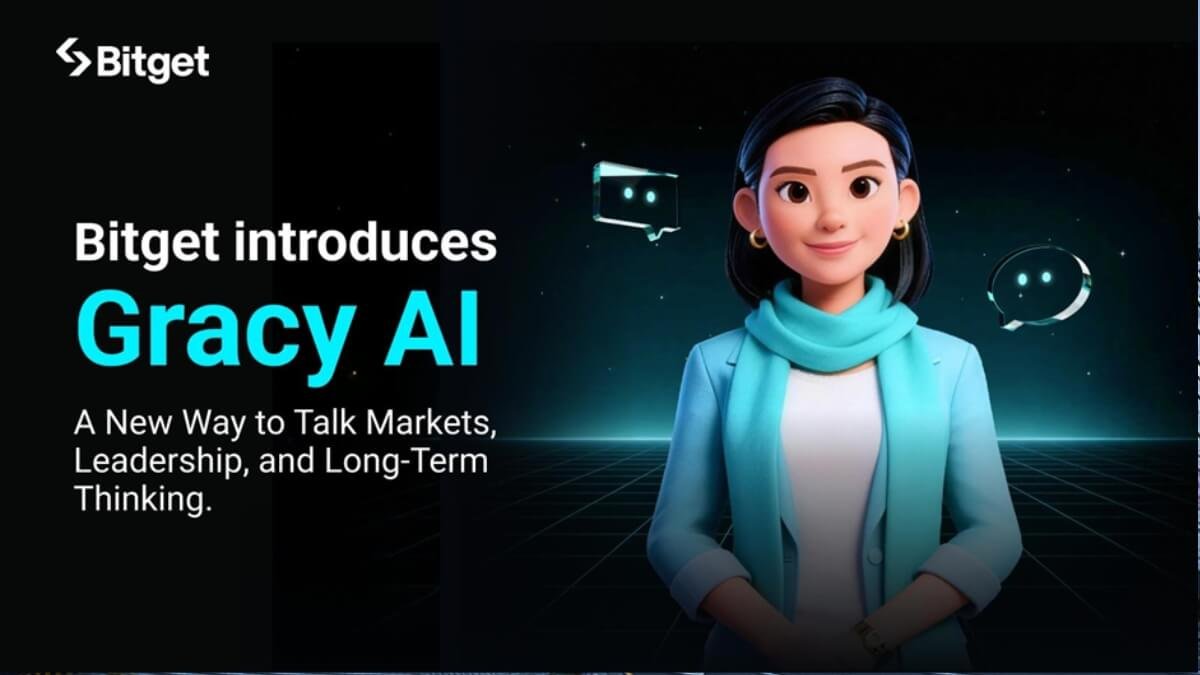
Bitget has rolled out an AI-powered “digital human” modeled on the thinking and communication style of CEO Gracy Chen. The launch widens the crypto exchange’s push to embed artificial intelligence into how retail users interpret markets rather than simply execute trades.
The product, branded Gracy AI, is designed as an animated, one-on-one conversational interface that Bitget says can field questions spanning market cycles, risk and strategy, and even career and mindset topics. This positioning Gracy AI less like a signal dashboard and more like an always-on “executive office hours” layer for users navigating volatile markets.
“Honestly, I still find it a little funny to see an AI avatar of me on screen,” Chen said. “But a big part of my job is listening to user concerns, getting close to the details, and helping people understand what’s really happening in the market. The team built Gracy AI around that same approach so more users can connect, learn and grow feeling supported by me and the team.”
A shift from “more data” to “more interpretation”
Crypto exchanges have spent years racing to add indicators, copy-trading feeds, and automation tools aimed at improving speed and convenience.
Bitget’s pitch for Gracy AI is different: the company is explicitly framing the avatar as an interpretation and context engine, not a price-prediction bot. This is an attempt to meet demand for narrative, mental models, and decision frameworks at a time when retail traders are confronted by increasingly complex market microstructure and nonstop information flow.
The move also reflects a broader pattern across the sector: AI features are moving up the stack from analytics to interface. Data firms have begun shipping chat-based tools designed to translate onchain activity and sentiment into natural-language answers—Nansen, for example, launched an AI chatbot aimed at helping users surface trade ideas from blockchain data and social signals.
Bitget’s launch lands in that same product lane, but with a different differentiation strategy: personality and leadership branding. Instead of selling “smarter alerts,” the exchange is packaging executive judgment—how to think about uncertainty, risk, and long-term direction—into a consumer-facing AI persona, betting that the value proposition for many users is guidance and framing rather than raw market calls.
How it fits Bitget’s “Universal Exchange” narrative
Gracy AI sits inside Bitget’s broader effort to reposition itself around what it calls a “Universal Exchange” model—an umbrella concept that ties together new trading access, simplified user workflows, and heavier use of AI to reduce friction for retail participants. Bitget has been public about this ambition, publishing materials describing a blueprint that extends beyond spot and derivatives into a more unified product stack.
The company is also linking Gracy AI directly to a roadmap that already includes GetAgent, an AI trading assistant it introduced earlier as an analytics and decision-support feature. In August 2025, Bitget announced GetAgent with tiered access and a focus on market analysis and strategy generation, positioning it as a toolset to help users navigate volatility with more structured signals.
In that context, Bitget is presenting Gracy AI as the “human-facing” complement to its more utilitarian AI layer: fewer dashboards, more dialogue—an attempt to build stickier engagement in an environment where exchanges increasingly compete on product experience rather than simply fees and listings.
Marketing hooks—and a bet on emotional utility
To promote adoption, Bitget is tying the launch to themed conversational prompts around seasonal moments such as Valentine’s Day and Lunar New Year, with “reflection and renewal” framing that leans closer to wellness and coaching than trading tools.
That approach shows the reality about AI in consumer finance: the biggest engagement gains often come not from marginally better indicators, but from lowering the psychological cost of decision-making—helping users feel guided, organized, and less overwhelmed. Whether that translates into better outcomes is harder to measure, and exchanges that deploy conversational AI must also manage reputational risk if users interpret guidance as investment advice.
The competitive backdrop: AI everywhere, differentiation harder
Across crypto, AI has become a default feature rather than a novelty. Exchanges and data platforms are layering in chat interfaces, automated strategy tooling, and AI-generated research summaries—partly to reduce user churn and partly to capture more of the “discovery” workflow that currently happens on social platforms.
Even in adjacent parts of the industry, executives have been explicit that AI adoption is moving from optional to expected: Coinbase CEO Brian Armstrong has described internal pressure to accelerate AI tool usage among employees, reflecting a broader Silicon Valley push to operationalize AI across product and engineering.
But, the big question is — can an executive-branded avatar become a durable moat—something users return to because it feels like relationship and mentorship—rather than a short-lived novelty. If the interface succeeds, it may foreshadow a new category of exchange differentiation: not just liquidity and product breadth, but “interpretation as a service,” with AI personas acting as personalized copilots for retail market participation.
What comes next will depend on user retention metrics and how Bitget governs the tool’s boundaries—particularly around the line between contextual education and actionable trading advice. For now, the company is betting that in markets defined by noise, the next competitive advantage may be less about sharper signals and more about clearer thinking.
The article “Bitget Launches “Gracy AI” Digital Human for Crypto Market Guidance” was first published on AlexaBlockchain. Read the complete article here: https://alexablockchain.com/bitget-launches-gracy-ai-digital-human/
Disclaimer: The information provided on AlexaBlockchain is for informational purposes only and does not constitute financial advice. Read complete disclaimer here.
Image Credits: Bitget, Shutterstock, Canva, Wiki Commons


