







Global markets are starting the new week in a defensive crouch, with investors rotating into traditional havens and selectively back into crypto as geopolitical risk, tariff uncertainty and questions around the Federal Reserve’s autonomy collide.
The shift has been most visible in precious metals. Gold and silver both pushed to fresh records in recent sessions, extending a rally that has accelerated as traders price a higher probability of policy shocks — from the Middle East to Washington. Gold climbed above $4,600/oz this week, while silver broke through $90/oz for the first time, a move that has left the metal within striking distance of psychologically charged round numbers.
At the center of the latest risk repricing is U.S. President Donald Trump’s threat to impose a 25% tariff on countries “doing business” with Iran, a step that would widen the Iran standoff into a broader trade channel and test the resilience of already-fragile global supply chains.
Tariffs move from headline risk to legal cliff edge
Tariff risk is also being reframed by the U.S. Supreme Court, which is poised to decide over the legality of Trump’s “global tariffs” imposed under the International Emergency Economic Powers Act (IEEPA) — a ruling that could reshape the boundaries of presidential authority over trade policy.
The uncertainty is feeding volatility in rate- and FX-sensitive assets because it hits markets through multiple channels at once: growth expectations, inflation risk via import costs, and corporate earnings visibility. Traders have also been watching prediction markets for signals of sentiment around the Court outcome, with some market chatter pointing to low odds of the tariffs being upheld — though those probabilities can swing quickly and aren’t a substitute for the legal fundamentals.
Fed independence becomes a market variable
What’s different this month is that investors are also treating central-bank governance — typically “background noise” — as a live macro factor.
Federal Reserve Chair Jerome Powell said the Justice Department served the Fed with grand jury subpoenas tied to his Senate testimony on cost overruns at the central bank’s renovation project, warning the probe threatened a criminal indictment and arguing the episode amounts to intimidation.
The political pressure has rippled beyond the U.S. Finnish central bank governor Olli Rehn warned that any loss of Fed independence risks structurally higher inflation and could undermine financial stability by eroding credibility in bond markets.
For traders, the immediate translation is straightforward: if confidence in the inflation-fighting framework is perceived to weaken, the premium for holding hard assets rises — one reason gold and silver have continued to outperform even as parts of the risk complex struggle to find footing.
Equities: fragile footing as banks kick off earnings
Equities have been choppy, and the early read from earnings season is doing little to calm nerves.
JPMorgan Chase posted results that beat expectations on the back of strong trading, but investors focused on weaker-than-anticipated investment-banking fees; the shares fell about 4% after the release, adding pressure to U.S. equity sentiment.
The broader message for equity markets is less about one quarter’s numbers and more about the macro backdrop: if tariffs and geopolitics keep risk premia elevated, underwriting and dealmaking can stay suppressed even when trading desks benefit from volatility.
FX: Yen slides toward “intervention zone” as politics bite
Currency markets are amplifying the macro crosscurrents. The Japanese yen has weakened sharply and flirted with levels that have historically triggered official pushback. Japanese authorities have stepped up warnings as USD/JPY approached the 160 area, framing the move as speculative and “one-sided,” while markets weigh the risk of direct intervention.
Political uncertainty is adding fuel: traders have been positioning around Japan’s election outlook and the possibility of expansionary fiscal policy, which can complicate the inflation-and-rates calculus for the Bank of Japan.
Commodities: havens soar, oil cools — but the risk premium lingers
In commodities, the divergence is telling.
- Gold and silver: The rally has been driven by a mix of geopolitical fear, policy uncertainty and haven demand, with record highs this week.
- Oil: Crude gave back part of its recent surge after Trump’s comments eased immediate fears of U.S. military escalation with Iran. Brent fell to roughly $64–$65/bbl and WTI to about $60/bbl, with inventories and oversupply concerns reinforcing the pullback even as geopolitical risks remain embedded in pricing.
This push-pull — a geopolitical bid versus structural oversupply anxieties — is one reason energy markets have been prone to sharp, headline-driven swings.
Crypto: Bitcoin rides the “non-sovereign hedge” narrative back toward $100,000
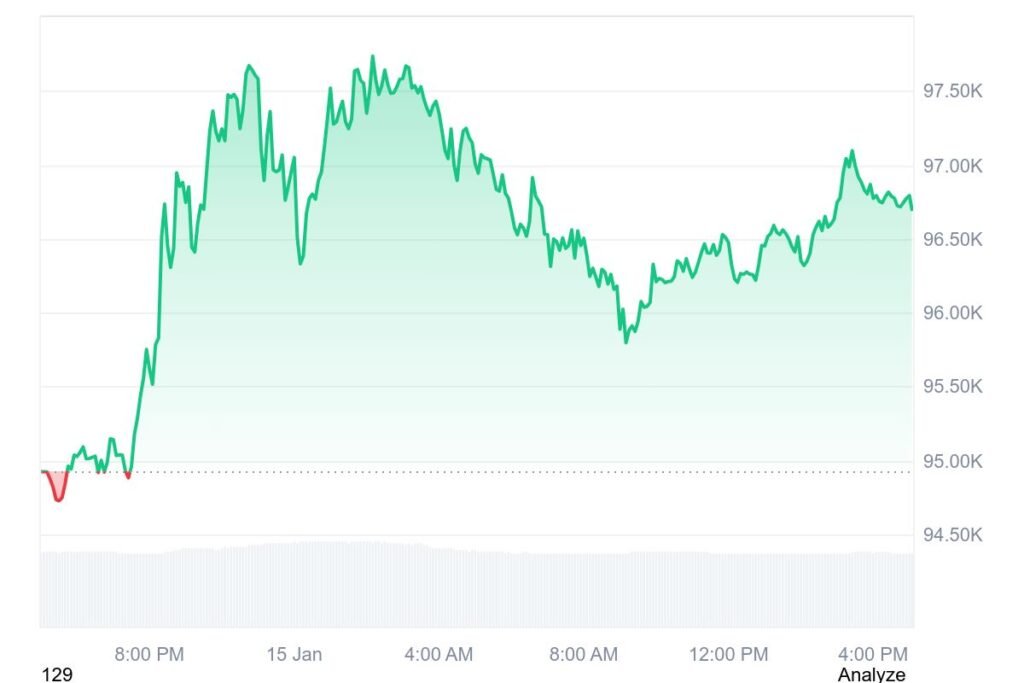
Bitcoin has reasserted itself in the macro conversation, climbing to a two-month high above $97,000 as investors digest softer inflation signals and the broader theme of institutional distrust in policy stability.
BTC was trading around $96,698 at the time of writing, after an intraday high near $97,758, according to data from CoinMarketCap.

That price action is drawing a parallel — increasingly common on trading desks — between “traditional” havens and crypto’s role as a non-sovereign store of value. Bitget CEO Gracy Chen argued that investors are building portfolios that blend gold exposure with Bitcoin, reflecting a more unified approach across TradFi and digital assets.
Chen also challenged the classic “altcoin season” playbook, suggesting crypto’s next phase may be more selective — with liquidity concentrating in higher-utility networks and regulated, real-world-asset-linked structures rather than broad speculative rallies. That view echoes a wider theme in crypto market structure as institutional participation deepens, though it remains contested among traders who still look for reflexive risk-on phases once macro volatility fades.
What investors are watching next
The near-term path for risk appetite now hinges on a handful of catalysts that could hit quickly and violently:
- The Supreme Court’s tariff decision, and what it implies about the durability and future scope of executive-driven trade policy.
- Iran escalation risk — where protest dynamics and U.S. posture are feeding commodity and FX hedging demand.
- Japan’s yen line in the sand, as officials signal readiness to act if depreciation becomes disorderly.
- The credibility premium for U.S. monetary policy, as the Powell subpoena fight keeps “Fed independence” in the pricing conversation.
As Lukman Otunuga of FXTM put it, markets are being “pulled in multiple directions,” a dynamic that tends to keep volatility elevated and encourages traders to stay hedged — even when pockets of risk appetite reappear.
Read Also:
Disclaimer: The information provided on AlexaBlockchain is for informational purposes only and does not constitute financial advice. Read complete disclaimer here.
Image Credits: CoinMarketCap, Shutterstock, Canva, Wiki Commons


